
Food Sensitivity vs Food Intolerance: What’s the Difference?
Quick answer
Do you eat a healthy salad only to look 6 months pregnant two hours later, leaving you panicked that you're suddenly allergic to every food on your plate?
When eating causes digestive distress or systemic fatigue, people often lump all food reactions together. However, food intolerance, food sensitivity, and food allergy represent entirely different biological mechanisms:
- Food Intolerance is a chemical/mechanical digestive issue—the body lacks specific enzymes (e.g., lactase) or transport mechanisms to break down food components, causing dose-dependent GI distress.
- Food Sensitivity is a vague, non-IgE systemic or gut-brain response—delayed, inconsistent symptoms (like bloating, brain fog, or joint aches) influenced by gut motility, stress, and nervous system reactivity.
- Food Allergy is a potentially life-threatening IgE immune reaction—the immune system misidentifies a protein as an invader, sparking immediate systemic symptoms (hives, throat swelling, anaphylaxis).
Understanding these distinctions prevents you from falling into the trap of over-restricting your diet and fearing normal nutrients.
Evidence and Decision Table
| Reaction Type | Biological Mechanism | Typical Symptoms | Onset & Dose Dependence | Primary Test / Next Step |
|---|---|---|---|---|
| Food Allergy | IgE Immune Response: Immune system attacks specific food proteins | Hives, lip/throat swelling, wheezing, vomiting, anaphylaxis | Immediate (minutes); strictly non-dose-dependent (even micro-grams trigger reaction) | Clinical IgE skin-prick test, blood test, or oral challenge by Allergist |
| Food Intolerance | Enzyme Defect or Malabsorption: Inability to digest sugars/compounds | Gas, abdominal cramping, watery diarrhea, severe bloating | Delayed (30 mins–3 hours); strongly dose-dependent (small amounts often tolerated) | Hydrogen breath test (for lactose/fructose) or targeted elimination-reintroduction |
| Food Sensitivity | Gut-Brain / Motility Sensitivity: Visceral nerve hypersensitivity | Vague bloating, brain fog, fatigue, irregular bowel movements | Delayed (hours to days); variable and influenced by stress, sleep, and meal size | 7 to 14-day food/symptom tracking log; avoid commercial IgG panel kits |
Demystifying the Mechanics: Missing Keys vs. Glitchy Car Alarms
To navigate food reactions, picture how your body interacts with incoming meals.
Food Intolerance: The Missing Key
Think of your digestive enzymes as specific keys designed to open chemical locks. In lactose intolerance, your body lacks the "lactase key." Unlocked lactose sugar cannot enter your bloodstream; instead, it travels down into your colon, where gut bacteria ferment it into gas while pulling water into the bowel. The issue is purely mechanical and enzymatic.
Food Sensitivity: The Glitchy Car Alarm
In food sensitivity, your gut-brain axis behaves like a glitchy, hyper-sensitive car alarm. Passing heavy trucks or a light breeze (normal food volume, mild fermentable carbohydrates, or high-fat meals) causes the alarm to blare loudly. The food itself is not toxic, but a combination of stress, poor sleep, constipation, and heightened visceral nerves turns normal digestion into uncomfortable symptoms.
3 Common Myths Debunked
Myth 1: "Commercial IgG blood test kits accurately identify all your food sensitivities."
The Reality: Major allergy and immunology societies worldwide (including AAAAI and EAACI) explicitly advise against using commercial IgG blood tests to diagnose food sensitivities. IgG antibodies reflect normal immune exposure and tolerance to foods you eat frequently—not allergy, intolerance, or disease. Basing elimination diets on IgG panels leads to unnecessary nutritional deprivation and anxiety.
Myth 2: "If a food makes you bloated once, you must eliminate it permanently."
The Reality: Intolerances and sensitivities are strongly dose-dependent and context-driven. Eating a slice of sourdough bread while relaxed and well-hydrated may cause zero symptoms, whereas eating three slices while stressed and constipated may cause distension. Food reactions are rarely all-or-nothing binaries.
Myth 3: "Food sensitivities are just mild food allergies."
The Reality: Food allergies involve IgE antibodies, mast cell degranulation, and immediate systemic risk (anaphylaxis). Food sensitivities do not involve acute IgE pathways and cannot trigger anaphylactic shock. Treating a mild motility response as a dangerous allergy creates unnecessary psychological fear around eating.
4-Step Action Plan to Identify True Triggers
Step 1: Benchmark Your Gut Sensitivity Baseline
Determine whether your reactions stem from slow transit, gas trapped behind stool, or true food component malabsorption.
- Action: Complete our interactive Gut Health Score to evaluate your motility profile.
Step 2: Differentiate Gas & Transit Disturbances
Analyze whether your symptoms represent simple trapped gas or a broader motility delay.
- Action: Read Bloating vs Gas: What’s the Difference? and compare transit issues in Constipation vs Slow Digestion: What’s the Difference?.
Step 3: Conduct a Controlled 7-Day Food & Symptom Log
Track meal composition, portion size, stress levels, eating speed, and bowel habits alongside symptom intensity instead of cutting out whole food groups randomly.
- Action: Utilize our 7-Day Gut-Friendly Fiber Plan and understand prebiotic interactions in Prebiotics vs Probiotics: What’s the Difference?.
Step 4: Systematically Reintroduce Foods and Expand Variety
If you eliminate a food temporarily, test reintroduction with small, escalating portion sizes to establish your personal threshold.
- Action: Learn to rebuild gut resilience by following How to Start a Gut-Friendly Diet Without Overcomplicating It.
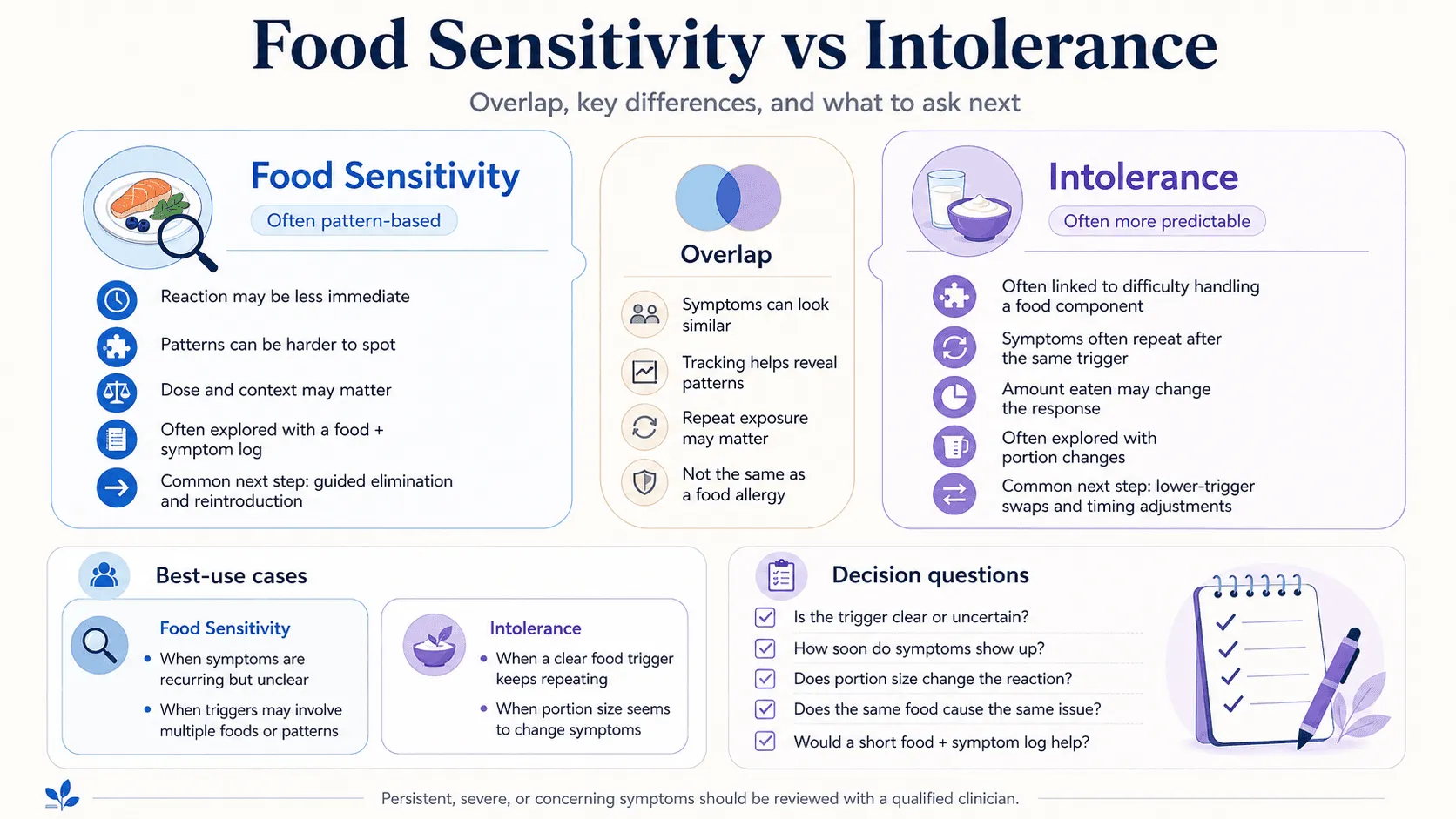
Decision Snapshot
| Symptom Pattern | Suspected Reaction | Recommended Next Step |
|---|---|---|
| Hives, swelling, wheezing, or throat tightness within 30 minutes | Food Allergy (IgE) | Immediate Emergency Care; see an Allergist for formal IgE diagnostic testing. |
| Gas, diarrhea, and cramps 1–2 hours after dairy products | Lactose Intolerance | Try a trial of lactase enzyme drops/pills or lactose-free dairy options; test threshold. |
| Vague bloating after complex meals during high-stress weeks | Food Sensitivity / IBS | Keep a 7-day symptom log; address sleep, eating speed, and stress; avoid broad elimination. |
| Bloating after apples, onions, garlic, or sugar-free mints | FODMAP Malabsorption | Temporarily reduce portion size of high-FODMAP foods; reintroduce systematically. |
Red-Flag Symptoms & YMYL Safety Boundaries
Food reactions can sometimes mask serious underlying medical conditions such as Celiac disease, Inflammatory Bowel Disease (Crohn's or Ulcerative Colitis), or severe anaphylactic food allergies.
Seek immediate emergency medical care (Call 911 or visit ER) if you experience:
- Swelling of the lips, tongue, face, or throat
- Difficulty breathing, shortness of breath, or high-pitched wheezing
- Feeling faint, dizzy, lightheaded, or passing out after eating
- Severe, acute vomiting or sudden systemic skin hives
Consult a gastroenterologist for non-emergency red flags:
- Unexplained, rapid weight loss or loss of appetite
- Visible blood in your stool, dark tarry stools, or chronic watery diarrhea
- Persistent night waking due to pain or bowel movements
- Iron-deficiency anemia or family history of Celiac disease/colon cancer
Medical Disclaimer
This comparison is for educational purposes only and does not replace medical advice, diagnosis, or allergy testing. Never attempt home exposure challenges if you suspect an IgE food allergy.
Sources
- FDA: Food Allergies—What You Need to Know - U.S. Food and Drug Administration
- NIAID Guidelines for the Diagnosis and Management of Food Allergy - National Institute of Allergy and Infectious Diseases
- NIDDK: Treatment for Lactose Intolerance
- EAACI Position Paper: Testing for IgG4 against Foods Is Not Recommended - European Academy of Allergy and Clinical Immunology
Continue with a focused next step
Move from understanding this topic to one practical action, goal, or supporting guide.
Related guide
Bloating vs Gas: What’s the Difference?
Gas is physical air, but bloating is trapped pressure or gut sensitivity. Learn the real root causes and follow a 4-step plan to relieve tightness.
Read guideRelated guide
Constipation vs Slow Digestion: What’s the Difference?
Is your gut bottleneck in the stomach or colon? Compare constipation vs slow digestion, debunk key fiber myths, and restore your digestive rhythm.
Read guideRelated guide
Prebiotics vs Probiotics: What’s the Difference?
Probiotics plant live seeds, but prebiotics provide the essential fertilizer. Discover how to combine them safely to relieve bloating and optimize gut health.
Read guideResearch & transparency
We explain the evidence context, keep recommendations proportional, and identify uncertainty where it matters.
When to seek professional support
This page is educational and cannot diagnose a condition. Seek qualified care for severe, persistent, or worsening symptoms.
- Symptoms are severe, sudden, or worsening
- The concern persists despite reasonable self-care
- You are pregnant, taking medication, or managing a condition