
Prebiotics vs Probiotics: What’s the Difference?
Quick answer
Have you bought expensive probiotic capsules expecting a complete digestive transformation, only to feel like nothing changed—or taken fiber supplements that turned your stomach into a noisy, bubbling balloon?
While both are praised as gut health essentials, prebiotics and probiotics play fundamentally different roles in your digestive ecosystem:
- Probiotics are live microorganisms (beneficial bacteria and yeasts) that, when consumed in adequate amounts, confer a demonstrated health benefit.
- Prebiotics are specialized non-digestible plant fibers that act as fuel, selectively feeding the beneficial microbes already resident in your colon.
To put it simply: Probiotics are the beneficial seeds; prebiotics are the rich fertilizer and soil. Taking probiotics without feeding them prebiotic fiber is like planting seeds in dry concrete.
Evidence and Decision Table
| Dimension / Feature | Prebiotics (Microbial Fuel) | Probiotics (Live Microorganisms) |
|---|---|---|
| Biological Definition | Non-digestible substrates selectively utilized by host microorganisms conferring a health benefit | Identified live microorganisms that confer a health benefit when administered in adequate amounts |
| Real-World Metaphor | Rich Fertilizer & Organic Compost: Nourishes and expands your existing native garden | Planted Seeds & Seasonal Guest Workers: Introduces live beneficial workers to perform temporary tasks |
| Primary Sources | Garlic, onions, leeks, oats, barley, chicory root (inulin), legumes, green bananas | Unpasteurized yogurt, kefir, kimchi, sauerkraut, strain-labeled probiotic capsules |
| Mechanism of Action | Fermented by colon bacteria into short-chain fatty acids (SCFAs like butyrate) | Interacts with gut mucosal immunity, competes with pathogens, modulates transit time |
| Colonization Potential | Indirectly supports long-term growth of native Bifidobacteria and Lactobacilli | Transient; most probiotic strains pass through the GI tract within days to weeks |
| Initial Side Effects | Gas, rumbling, and mild bloating if introduced too quickly in large amounts | Temporary changes in stool frequency or mild gas during initial adjustment |
| Best Long-Term Strategy | Daily foundational habit via plant-rich diet or targeted soluble fiber | Targeted supplementation for specific health conditions, antibiotic recovery, or IBS |
Demystifying the Mechanics: Planted Seeds vs. Rich Fertilizer
To build a resilient gut, understand how seeds and fertilizer interact inside your intestinal microbiome garden.
Probiotics: Planted Seeds and Guest Workers
When you swallow a probiotic capsule containing 10 Billion CFUs of Bifidobacterium, you are introducing millions of microscopic planted seeds and guest workers into your gut. These organisms do not permanently move into your colon and build lifelong homes; instead, as they travel through your digestive tract, they produce lactic acid, crowd out harmful pathogens, and interact with your immune cells before passing through.
Prebiotics: Rich Fertilizer and Soil Nourishment
Prebiotics pass completely undigested through your stomach and small intestine, arriving intact in your colon. Think of prebiotics as rich organic fertilizer. Your resident gut microbes devour these specialized fibers (such as inulin, resistant starch, and oligosaccharides) and ferment them into short-chain fatty acids (SCFAs) like butyrate, acetate, and propionate. Butyrate feeds your intestinal lining cells, strengthens gut barrier tight junctions, and lowers inflammation.
3 Common Myths Debunked
Myth 1: "Taking a daily probiotic supplement permanently alters your gut microbiome forever."
The Reality: Stool sequencing studies confirm that most commercial probiotic strains are transient visitors. They do not permanently colonize an adult gut after a few weeks of pill consumption. Permanent microbiome shifts require changing your daily prebiotic dietary environment to sustain beneficial bacteria over months and years.
Myth 2: "Every dietary plant fiber is automatically a prebiotic."
The Reality: All prebiotics are fiber, but not all fibers are prebiotics. For a fiber to meet the official scientific definition of a prebiotic (ISAPP consensus), it must be selectively utilized by beneficial host microorganisms to produce demonstrated health benefits. Insoluble wheat bran adds bulk to stool but is not a true prebiotic.
Myth 3: "If taking a prebiotic fiber causes gas, it means it is ruining your gut."
The Reality: Initial gas and audible rumbling after increasing prebiotic fiber are usually signs that your resident bacteria are actively fermenting the fuel and producing beneficial gases and SCFAs. If gas is intense, it simply indicates your dose was too high too fast—not that prebiotics are harmful.
4-Step Action Plan to Build Your Microbial Garden
Step 1: Benchmark Your Gut Ecosystem Readiness
Evaluate whether your gut motility and microbial balance are prepared for increased prebiotic fiber or require targeted strain support first.
- Action: Complete our interactive Gut Health Score.
Step 2: Establish a Prebiotic Food Foundation
Layer prebiotic-rich plant foods into your daily meals before spending money on high-dose fiber powders.
- Action: Learn how gas and bloating interact in Bloating vs Gas: What’s the Difference? and check transit dynamics in Constipation vs Slow Digestion: What’s the Difference?.
Step 3: Deploy Targeted Probiotics for Specific Needs
If you are recovering from antibiotic therapy, traveling abroad, or managing IBS bloating, select a tested strain formulation.
- Action: Explore top-rated formulations in our guide to Best Probiotics for Digestive Support and Best Probiotics for Bloating: What to Look For Before You Buy.
Step 4: Safely Titrate Prebiotic Fibers and Synbiotics
Combine compatible probiotics and prebiotics (synbiotics) while gradually stepping up fiber dosage alongside adequate hydration.
- Action: Learn how probiotics combat distension in Can Probiotics Help With Bloating? and find top fiber options in Best Prebiotic Supplements for Gut Health.
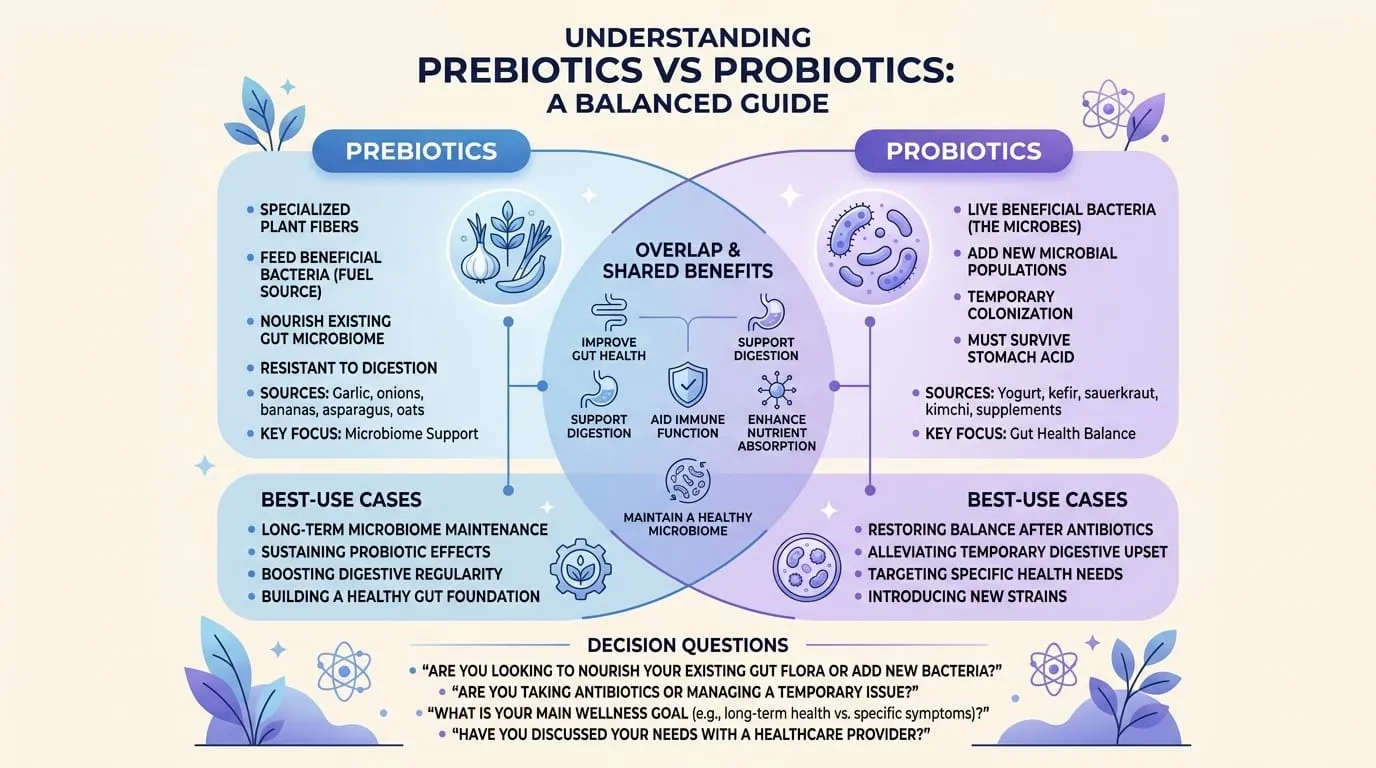
Decision Snapshot
| Health Goal | Primary Choice | Key Reason |
|---|---|---|
| Long-Term Daily Gut Health | Prebiotic Foods (Garlic, Oats, Onions, Legumes) | Nourishes native microflora; promotes sustained SCFA (butyrate) production. |
| Post-Antibiotic Gut Recovery | Targeted Probiotic Supplement | Replenishes transient beneficial cultures to prevent pathogen overgrowth. |
| Low-Fiber Constipation | Prebiotic Soluble Fiber (Inulin / GOS) | Increases bacterial biomass and stool moisture to improve lower gut transit. |
| Active SIBO / Severe IBS Flare | Low-FODMAP Diet / Single-Strain Probiotic | High-dose prebiotics can feed small bowel bacteria during active SIBO flares. |
Red-Flag Symptoms & Medical Boundaries
While prebiotics and probiotics are safe dietary components for the general population, specific clinical conditions require strict medical supervision.
Do not take high-dose probiotic supplements or concentrated prebiotic fiber powders without medical clearance if you have:
- Severe immunocompromise (undergoing chemotherapy, organ transplant, or advanced immunosuppressive therapy)
- Central venous catheters or vascular access lines (risk of bacteremia/fungemia)
- Active Small Intestinal Bacterial Overgrowth (SIBO) or severe intestinal strictures/obstructions
- Red-flag symptoms: high fever, severe bloody stools, rapid unexplained weight loss, or severe acute abdominal pain
Medical Disclaimer
This article is for educational purposes only and does not constitute medical advice or diagnosis. Always consult a qualified physician or clinical dietitian before introducing high-dose supplements or making major dietary changes.
Sources
- ISAPP Consensus Statement on the Definition and Scope of Prebiotics - Nature Reviews Gastroenterology & Hepatology
- NIH ODS: Probiotics Fact Sheet for Health Professionals - National Institutes of Health
- NCCIH: Probiotics—Usefulness and Safety
- AGA Clinical Practice Guidelines on Probiotics in Gastrointestinal Disorders - Gastroenterology
Continue with a focused next step
Move from understanding this topic to one practical action, goal, or supporting guide.
Related guide
Can Probiotics Help With Bloating?
Can probiotics stop severe bloating? Learn when a probiotic trial makes sense, why SIBO complicates bloating, and how to select the right strains.
Read guideRelated guide
Best Probiotics for Digestive Support
Review strain-specific probiotic supplements for overall digestive health. Compare evidence, CFU counts, label transparency, and trial protocols.
Read guideRelated guide
Best Probiotics for Bloating: What to Look For Before You Buy
Struggling with post-meal bloating and gas? Review top strain-specific probiotics for bloating, clinical evidence, buying checklists, and trial protocols.
Read guideResearch & transparency
We explain the evidence context, keep recommendations proportional, and identify uncertainty where it matters.
When to seek professional support
This page is educational and cannot diagnose a condition. Seek qualified care for severe, persistent, or worsening symptoms.
- Symptoms are severe, sudden, or worsening
- The concern persists despite reasonable self-care
- You are pregnant, taking medication, or managing a condition