
Bloating vs Gas: What’s the Difference?
Quick answer
Are you secretly unbuttoning your pants under the dinner table, feeling as though your stomach is inflating like a pressure cooker, even though you can't pass any air to relieve the tightness?
While people often use the terms interchangeably, gas and bloating are fundamentally different digestive events:
- Gas is a physical byproduct—air or bacterial fermentation gases (hydrogen, methane, carbon dioxide) moving through your digestive tract.
- Bloating is a sensory experience and mechanical pressure—an uncomfortable sensation of tightness, fullness, or visible abdominal expansion (distension).
Understanding whether your primary issue is excess gas production, slow gut motility, or visceral nerve hypersensitivity is the key to choosing a targeted solution that actually works.
Side-by-Side Comparison
| Feature / Question | Digestive Gas | Abdominal Bloating |
|---|---|---|
| Primary Nature | Physical material (air swallowed or gas generated by microbes) | Sensory feeling of internal tightness, fullness, or visible swelling |
| Real-World Metaphor | Engine Exhaust: The natural byproduct of burning fuel (fiber fermentation) | Pressure Cooker Steam Trap: Pressure build-up when steam cannot escape or walls feel strained |
| Physical Mechanism | Fermentation of unabsorbed carbohydrates by gut microbes in the colon | Delayed stomach emptying, constipation, fluid shifts, or gut-brain nerve sensitivity |
| Visible Sign | Belching or flatulence; belly may remain completely flat | Belly often visibly expands by afternoon (distension) or feels rock-hard |
| Immediate Relief | Passing gas or belching usually brings instant comfort | Passing gas may offer little relief if constipation or motility is the main cause |
| Primary Solution Focus | Adjust fermentable fiber intake, reduce swallowed air, refine eating speed | Improve intestinal motility, relieve constipation, calm visceral hypersensitivity |
Demystifying the Mechanics: Exhaust Fumes vs. Pressure Cooker Traps
To fix your gut discomfort, you must understand how gas forms and how bloating occurs.
Gas: The Engine Exhaust of Digestion
Think of your digestive tract as a complex engine powered by food. When you eat complex plant fibers, your small intestine cannot break all of them down. They travel to your large intestine, where trillions of beneficial bacteria ferment them. This process creates beneficial short-chain fatty acids (SCFAs), but it also produces gas. Gas is simply the exhaust fumes of a healthy microbial engine.
Bloating: The Pressure Cooker Steam Trap
Bloating occurs when those exhaust gases cannot move freely, or when your intestinal walls are hyper-sensitive to normal gas volumes. Imagine a pressure cooker with a faulty release valve:
- Motility Stalls: If stool is backed up (constipation) or gut transit is slow, gas gets trapped behind intestinal bends, building intense upward pressure.
- Gut-Brain Alarm Glitches: In a sensitive gut, normal amounts of gas stretch the intestinal lining, causing the nervous system to send high-alert pain signals to the brain even when total gas volume is normal.
3 Common Myths Debunked
Myth 1: "Bloating is always caused by having too much gas in your stomach."
The Reality: Clinical imaging shows that many people suffering from severe abdominal bloating actually have the exact same volume of intestinal gas as non-bloated individuals. Their bloating is driven by visceral hypersensitivity (heightened nerve sensation), abnormal diaphragm-abdominal muscle reflexes, slow transit time, or fluid retention—not excess gas volume alone.
Myth 2: "Passing gas is a sign that your digestive system is broken."
The Reality: The average healthy human passes gas 10 to 20 times per day. Gas is proof that your gut microbes are actively consuming prebiotic fiber and producing gut-protective compounds. Eliminating all gas production would require starving your microbiome of beneficial nutrients.
Myth 3: "Popping anti-gas pills like simethicone will cure your chronic bloating."
The Reality: Simethicone works by breaking small gas bubbles into larger bubbles so they can be belched out more easily. However, if your bloating is caused by constipation, slow stomach emptying, high-FODMAP food fermentation, or gut-brain nerve misfiring, anti-gas drops will do virtually nothing to relieve the pressure.
4-Step Action Plan to Calm Gas & Stop Bloating
Step 1: Identify Your Primary Symptom Pattern
Determine whether your discomfort stems from trapped air, slow transit, or food intolerance.
- Action: Complete our interactive Gut Health Score to evaluate your motility rhythm and symptom profile.
Step 2: Uncover Hidden Food and Motility Triggers
Keep a 7-day log of your meal speed, portion sizes, carbonated beverage intake, and stress levels alongside your bloating scores.
- Action: Read Common Bloating Triggers and How to Find Yours and investigate Why Do I Feel Bloated After Eating?.
Step 3: Eliminate Underlying Colon Traffic Jams
If stool is moving slowly, gas becomes trapped behind it. Resolving constipation is frequently the single most effective way to cure daily bloating.
- Action: Explore how lower gut speed drives pressure in Constipation and Bloating: Why They Happen Together and review targeted options in our guide to Best Probiotics for Bloating.
Step 4: Titrate Fiber and Calibrate Probiotics Gradually
Avoid jumping from a low-fiber diet to massive fiber servings overnight, which can overwhelm gut bacteria and spark intense gas.
- Action: Follow our guide on Why Fiber Can Make You Bloated at First and evaluate whether targeted strains can assist via Can Probiotics Help With Bloating?.
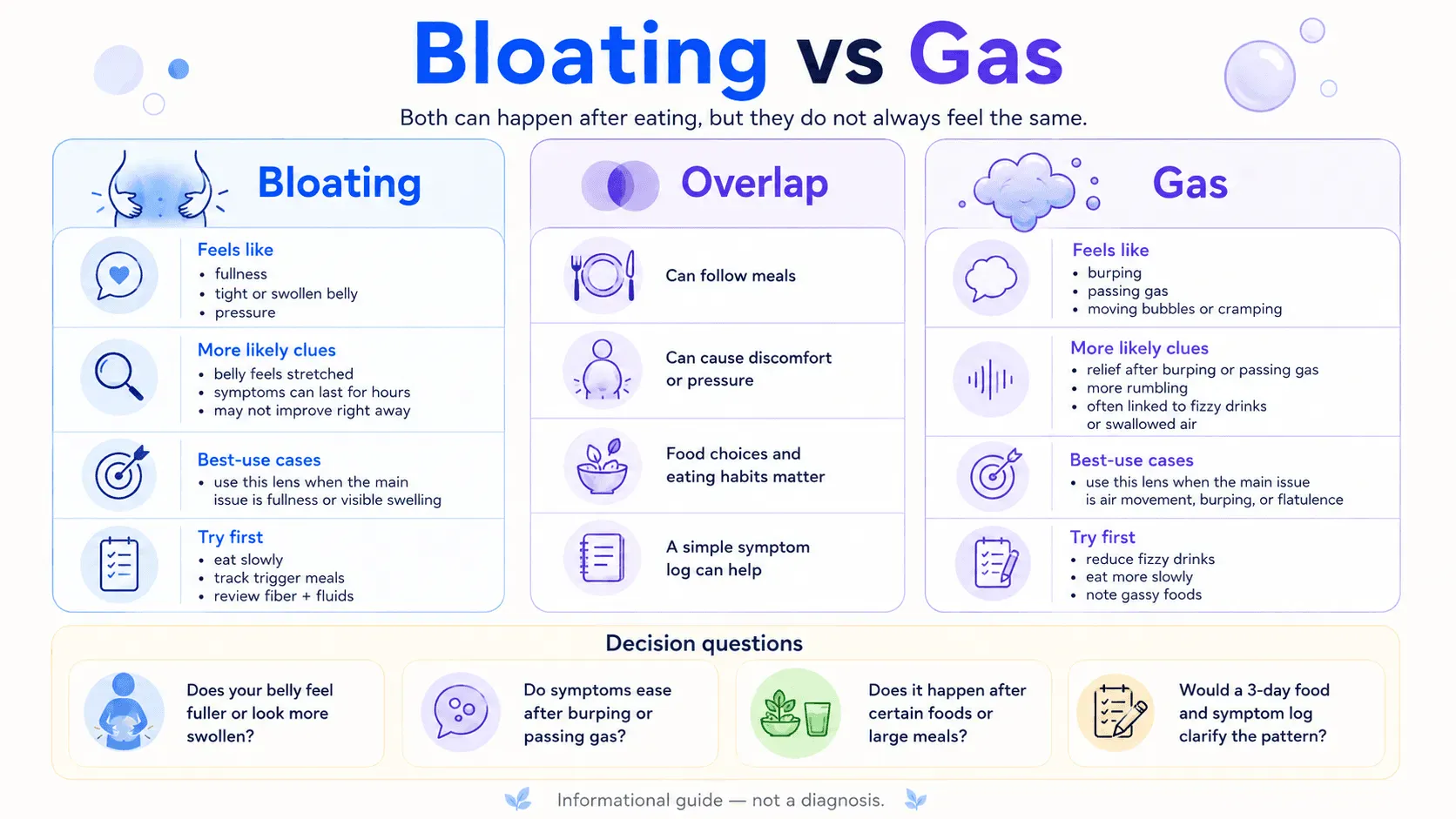
Decision Snapshot
| Symptom Pattern | Primary Cause | Recommended First Step |
|---|---|---|
| Immediate relief after passing gas / burping | Swallowed air or rapid fiber fermentation | Slow down eating speed; modify high-FODMAP food portions. |
| Belly expands like a balloon as the day goes on | Slow motility or visceral nerve hypersensitivity | Resolve constipation; try gentle post-meal walking and motility support. |
| Bloating paired with hard, infrequent stools | Colon traffic jam (constipation) | Increase soluble fiber slowly with plenty of fluids; check stool transit. |
| Sudden pain after carbonated drinks or chewing gum | Swallowed air (aerophagia) | Eliminate carbonation, straws, and sugar alcohols like sorbitol/xylitol. |
Red-Flag Symptoms & Medical Boundaries
While occasional bloating and gas are normal digestive experiences, persistent or sudden symptoms can indicate underlying medical conditions such as Celiac disease, Inflammatory Bowel Disease (IBD), Small Intestinal Bacterial Overgrowth (SIBO), or gynaecological conditions.
Seek prompt medical evaluation if your bloating or gas is accompanied by:
- Unexplained, rapid weight loss
- Visible blood in your stool or black, tarry stools
- Severe, localized abdominal pain or pain that wakes you up at night
- Persistent vomiting, inability to keep fluids down, or chronic diarrhea
- Unexplained fever, anemia, or post-menopausal abdominal swelling
Medical Disclaimer
This article is for educational purposes only and does not constitute medical advice. Always consult a physician or gastroenterologist for persistent digestive distress, severe abdominal distension, or major changes in bowel habits.
Sources
- NIDDK: Symptoms & Causes of Gas in the Digestive Tract - National Institute of Diabetes and Digestive and Kidney Diseases
- NIDDK: Symptoms & Causes of Constipation
- ACG Clinical Guideline: Management of Irritable Bowel Syndrome - American College of Gastroenterology
Continue with a focused next step
Move from understanding this topic to one practical action, goal, or supporting guide.
Related guide
Why Do I Feel Bloated After Eating?
Tired of unbuttoning your pants after meals? Understand why post-meal bloating occurs and follow 4 actionable steps for fast, natural relief.
Read guideRelated guide
Common Bloating Triggers and How to Find Yours
Identify your personal bloating triggers without extreme food restriction. Learn the 4 primary trigger pathways and how to pinpoint culprits systematically.
Read guideRelated guide
Constipation and Bloating: Causes, First Steps and Red Flags
Understand constipation with bloating, what to track, gradual first steps and when to seek care. Daily bowel movements do not rule out constipation.
Read guideResearch & transparency
We explain the evidence context, keep recommendations proportional, and identify uncertainty where it matters.
When to seek professional support
This page is educational and cannot diagnose a condition. Seek qualified care for severe, persistent, or worsening symptoms.
- Symptoms are severe, sudden, or worsening
- The concern persists despite reasonable self-care
- You are pregnant, taking medication, or managing a condition