
Constipation vs Slow Digestion: What’s the Difference?
Quick answer
Do you wake up feeling like last night’s dinner is still sitting heavy in your upper stomach, or spend agonizing minutes in the bathroom straining for a bowel movement that leaves you feeling incompletely emptied?
While people often use "slow digestion" and "constipation" as synonyms for a sluggish gut, they originate from different parts of your digestive tract:
- Constipation is specifically a issue of lower gut transit and stool consistency in the colon and rectum—marked by infrequent bowel movements, hard/lumpy stools, straining, or incomplete evacuation.
- Slow Digestion is a broader description of delayed upper GI motility, such as slow stomach emptying (gastric delay) or delayed small intestine movement, creating heaviness, early fullness, nausea, and upper abdominal bloating.
Distinguishing whether your bottleneck is in the upper stomach highway or the lower colon conveyor belt dictates whether you need dietary fiber, motility support, digestive routine adjustments, or medical evaluation.
Evidence and Decision Table
| Feature / Comparison | Constipation | Slow Digestion (Delayed Motility) |
|---|---|---|
| Primary Location | Lower GI tract (Colon, Rectum, Pelvic Floor) | Upper GI tract (Stomach, Small Intestine) or systemic motility |
| Real-World Metaphor | Dried-Out Conveyor Belt: Waste moves so slowly through the colon that all moisture is sucked dry | Gridlocked Highway Toll Plaza: Food idles in the stomach, taking hours to pass into the intestine |
| Primary Symptoms | Hard/pebbly stools, straining, bowel movements < 3 times per week, feeling blocked | Early fullness after a few bites, upper stomach heaviness, nausea, post-meal bloating |
| Fiber Response | Soluble gel-forming fiber (e.g., psyllium) frequently improves stool form and transit | High coarse fiber can sometimes worsen upper heaviness if stomach emptying is impaired |
| Water Intake Role | Essential; colon reabsorbs water from slow-moving waste, hardening stool | Hydration supports overall function but won't single-handedly speed up stomach emptying |
| Key Risk Factors | Low soluble fiber, dehydration, sedentary lifestyle, pelvic floor dysfunction | Gastroparesis, high-fat heavy meals, diabetes, thyroid disease, high stress |
Demystifying the Mechanics: Gridlocked Highways vs. Dried-Out Conveyor Belts
Understanding how food moves through your digestive system reveals why these two conditions require different approaches.
Slow Digestion: The Gridlocked Upper Highway
When you swallow food, your stomach acts as a mixing chamber, using muscular contractions (peristalsis) and acid to convert solid food into a smooth liquid (chyme). In slow digestion, stomach contractions are sluggish. Picture a highway toll plaza with only one lane open: food sits in the stomach for hours instead of moving smoothly into the small intestine, causing nausea, burping, and a heavy brick-like feeling under your ribs.
Constipation: The Dried-Out Colon Conveyor Belt
Once nutrients are absorbed in the small intestine, remaining waste enters the colon—a 5-foot conveyor belt. The colon's job is to absorb water and form solid stool. If colon transit is delayed, waste stays on the belt far too long. The colon continuously pulls water out of the waste, transforming soft stool into hard, dry, painful pebbles that are difficult to evacuate.
3 Common Myths Debunked
Myth 1: "You must have a bowel movement every single day to avoid self-poisoning."
The Reality: Healthy bowel frequency varies widely, from 3 times a day to 3 times a week. The myth of "autointoxication" (that retained stool poisons the body) was debunked over a century ago. What matters far more than a rigid daily clock is stool consistency, lack of straining, and complete comfort after evacuation.
Myth 2: "Taking harsh stimulant laxatives will fix slow stomach digestion."
The Reality: Stimulant laxatives (like senna or bisacodyl) work by irritating the lining of the large intestine to force colon contractions. They have zero effect on stomach emptying or small intestine motility. Using them for upper stomach heaviness is like replacing your car's rear tires when the engine block is stalled.
Myth 3: "Drinking gallons of water alone will instantly solve chronic constipation."
The Reality: While chronic dehydration certainly worsens constipation, over-hydrating beyond normal physiological needs will not magically soften stool unless adequate soluble gel-forming fiber is present in the colon to hold onto that water. Without fiber, excess water is simply filtered by the kidneys and urinated out.
4-Step Action Plan to Restore Digestive Rhythm
Step 1: Pinpoint Your Digestive Bottleneck
Determine whether your symptoms stem from upper stomach delay or lower bowel blockage.
- Action: Take our comprehensive Gut Health Score to evaluate your transit patterns and motility score.
Step 2: Understand Upper vs. Lower Motility Interactions
Learn how upper stomach delay and lower colon traffic jams interact to exacerbate bloating.
- Action: Read How Digestion Works: A Simple Guide and understand why lower blockages trap upper gas in Constipation and Bloating: Why They Happen Together.
Step 3: Upgrade Soluble Fiber and Hydration Staggering
If lower gut constipation is your primary issue, gradually introduce viscous soluble fiber while ensuring balanced hydration throughout the day.
- Action: Incorporate gentle plant fibers from Best High-Fiber Foods for Better Digestion and explore tested supplements in our guide to Best Fiber Supplements for Constipation and Gut Health.
Step 4: Downregulate Nervous System Stress Signals
The vagus nerve directly controls stomach emptying and intestinal motility. Chronic fight-or-flight signaling slows stomach contractions and triggers gut spasms.
- Action: Address stress-induced gut slowdown with insights from Best Supplements for Stress-Related Digestive Discomfort.
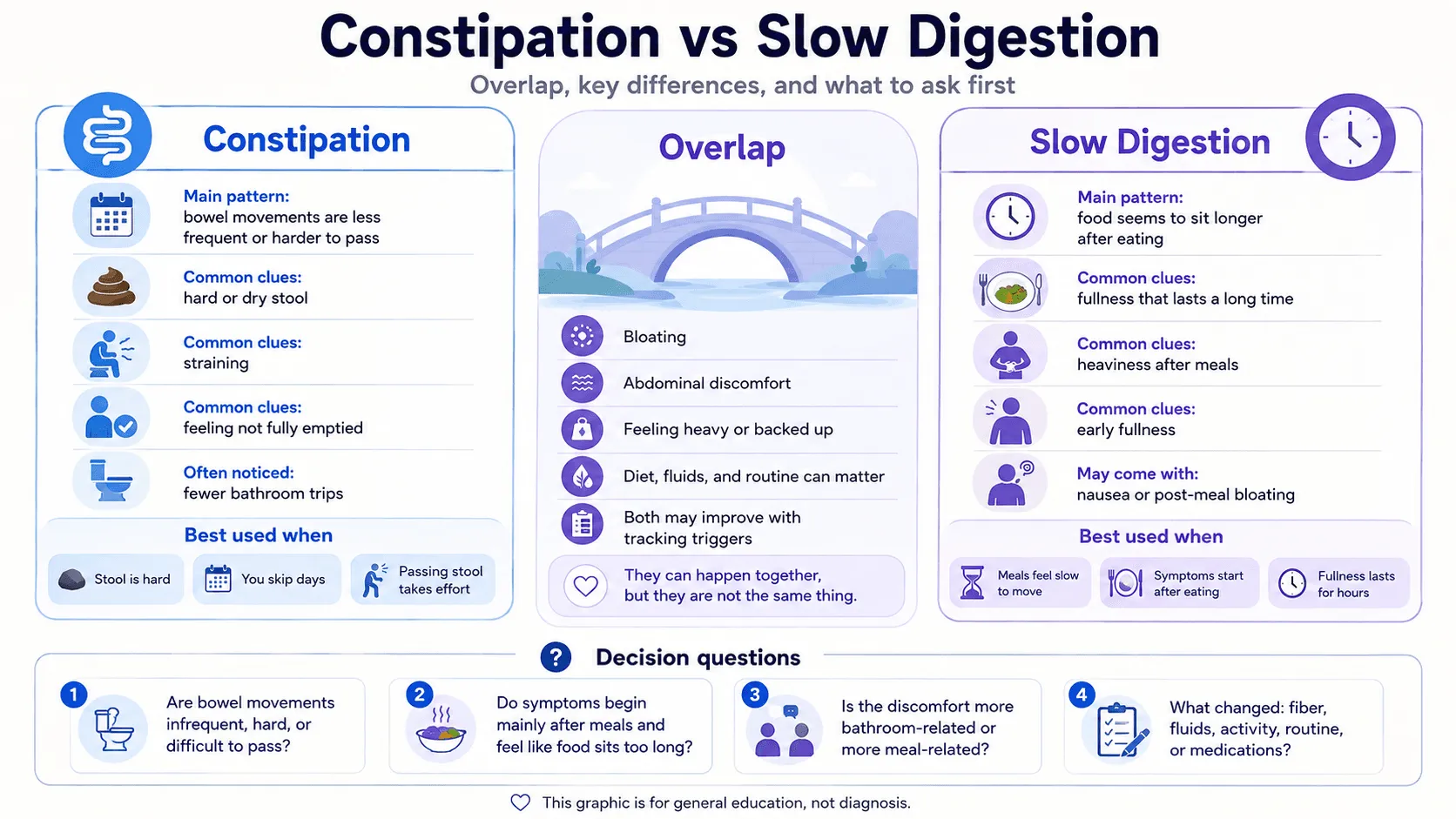
Decision Snapshot
| Primary Symptom Pattern | Most Likely Condition | Recommended Action |
|---|---|---|
| Hard pebbles, severe straining, bowel movements < 3x/week | Lower GI Constipation | Increase soluble gel-forming fiber (psyllium), maintain hydration, check pelvic alignment. |
| Fullness after a few bites, nausea, stomach heaviness | Upper Slow Digestion (Gastric Delay) | Eat smaller, low-fat liquid/soft meals; remain upright after eating; seek medical evaluation. |
| Both upper heaviness AND severe lower stool blockage | Combined Motility Slowdown | Address the lower bowel blockage first; colon relief often restores upper stomach emptying reflex. |
| Sudden constipation starting after a new medication | Medication-Induced Slowdown | Review prescriptions (opioids, iron supplements, antacids, anticholinergics) with your doctor. |
Red-Flag Symptoms & Medical Safety Boundaries
While mild constipation and occasional sluggish digestion can often be managed through diet and lifestyle adjustments, persistent upper or lower GI symptoms require thorough medical evaluation to rule out conditions such as gastroparesis, intestinal obstruction, hypothyroidism, Celiac disease, or colorectal pathology.
Seek prompt medical attention if you experience:
- Blood in your stool (bright red or dark black/tarry)
- Persistent, unexplained vomiting or inability to keep liquids down
- Rapid, unintentional weight loss or loss of appetite
- Severe, constant, or worsening abdominal pain
- Fever, night sweats, or feeling a palpable mass in your abdomen
- Sudden, drastic change in bowel habits after age 50
Medical Disclaimer
This content is strictly for educational purposes and does not replace medical diagnosis or treatment. Consult a licensed physician or gastroenterologist for persistent digestive issues, severe constipation, or nausea.
Sources
- NIDDK: Definition & Facts for Constipation - NIDDK
- NIDDK: Symptoms & Causes of Gastroparesis
- ACG Clinical Guideline: Management of Irritable Bowel Syndrome - American College of Gastroenterology
Continue with a focused next step
Move from understanding this topic to one practical action, goal, or supporting guide.
Related guide
Constipation and Bloating: Causes, First Steps and Red Flags
Understand constipation with bloating, what to track, gradual first steps and when to seek care. Daily bowel movements do not rule out constipation.
Read guideRelated guide
High-Fiber Foods: Portions, Meal Ideas and Bloating Tips
Compare high-fiber foods with reference portions, practical meal ideas and ways to increase gradually. Learn when bloating needs individual advice.
Read guideRelated guide
How Digestion Works: A Simple Guide
Explore the 6 stations of your body's digestive assembly line. Learn how stomach acid, enzymes, and motility work together for effortless digestion.
Read guideResearch & transparency
We explain the evidence context, keep recommendations proportional, and identify uncertainty where it matters.
When to seek professional support
This page is educational and cannot diagnose a condition. Seek qualified care for severe, persistent, or worsening symptoms.
- Symptoms are severe, sudden, or worsening
- The concern persists despite reasonable self-care
- You are pregnant, taking medication, or managing a condition