
Soluble vs Insoluble Fiber: Which Is Better?
Quick answer
Do you eat a giant bowl of raw kale or coarse wheat bran cereal hoping to fix your constipation, only to suffer agonizing abdominal cramps and intense bloating an hour later?
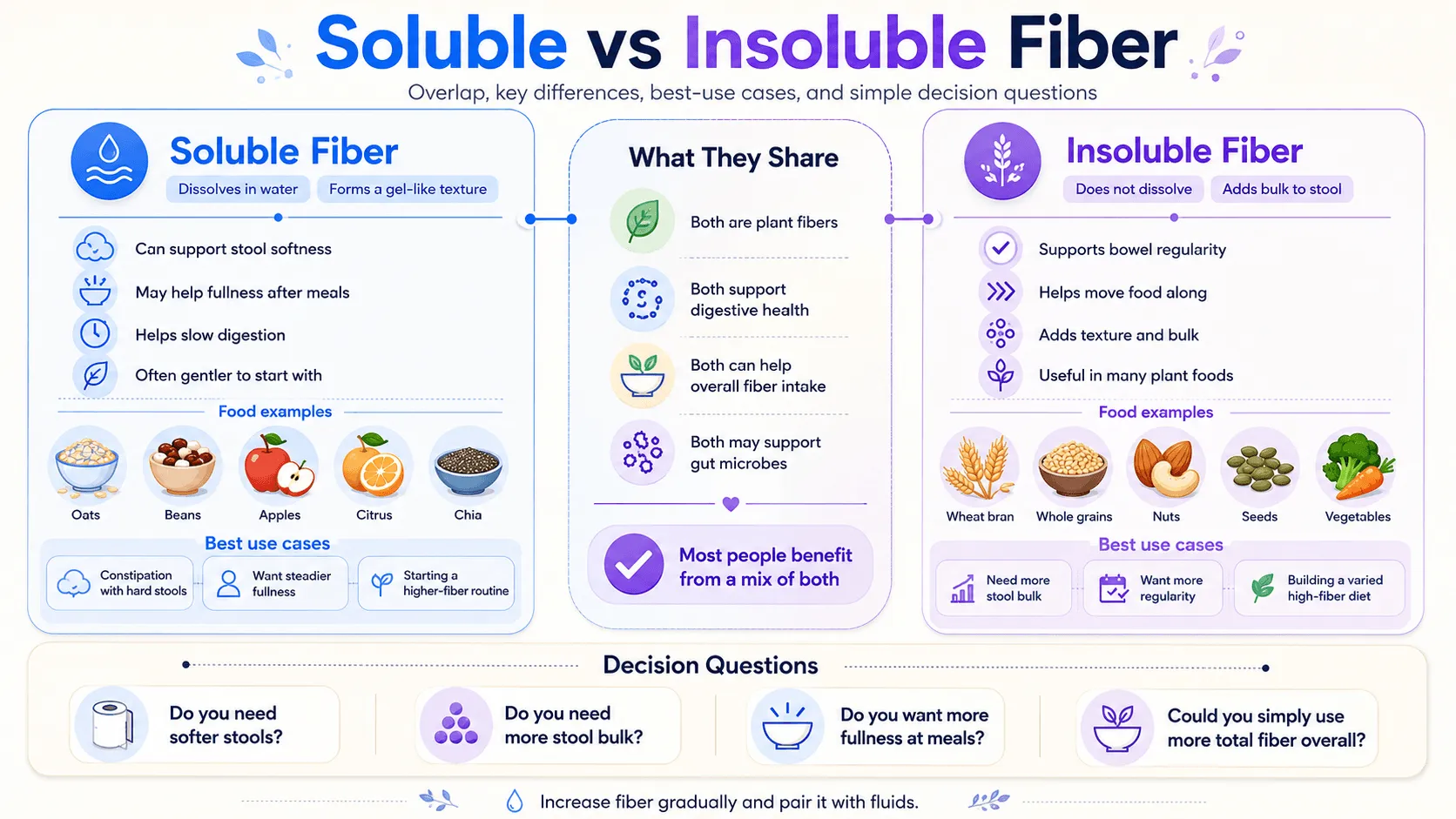
While nutrition labels lump all dietary fiber into a single gram total, soluble fiber and insoluble fiber behave completely differently inside your digestive tract:
- Soluble Fiber dissolves in water to form a viscous, soothing gel that softens hard stool, slows down rapid transit, and feeds beneficial gut microbes.
- Insoluble Fiber does not dissolve in water; it acts as structural roughage, adding bulk to stool and stimulating mechanical contractions to sweep waste through the colon.
If you suffer from IBS, gas, or sensitive digestion, soluble viscous fiber (like psyllium or oats) is significantly gentler and better supported by clinical guidelines than coarse insoluble bran.
Evidence and Decision Table
| Feature / Property | Soluble Fiber (Gel-Forming & Fermentable) | Insoluble Fiber (Structural Bulk) |
|---|---|---|
| Water Solubility | Dissolves in water to form a smooth, viscous gel | Does not dissolve in water; retains rigid structure |
| Real-World Metaphor | The Water-Absorbing Sponge: Soaks up fluid to form a soft gel that balances stool form | The Stiff Kitchen Broom: Sweeps through the intestine to physically scrape and push waste forward |
| Primary Food Sources | Oats, barley, psyllium husk, chia seeds, beans, apples, carrots, avocados | Wheat bran, whole grains, nuts, seeds, fruit skins, cauliflower, green beans |
| Gut Microbiome Role | Highly fermentable by colon bacteria; produces beneficial short-chain fatty acids | Minimally fermentable; primarily provides physical bulk and structural movement |
| Effect on Stool Form | Normalizes both hard and loose stools by retaining water inside the stool matrix | Increases total stool volume and speeds up colon transit time |
| IBS Guideline Support | High (Recommended by the American College of Gastroenterology for IBS) | Low (Coarse wheat bran can aggravate pain and gas in sensitive IBS sufferers) |
Demystifying the Mechanics: Water-Absorbing Sponges vs. Stiff Kitchen Brooms
To select the right fiber for your digestive system, visualize how these two fiber structures interact with liquid inside your gut.
Soluble Fiber: The Water-Absorbing Sponge
Picture dropping a dry sponge into a bowl of water. It swells up, holding onto the fluid to create a soft, slippery, cohesive mass. This is exactly what soluble fiber (like psyllium husk or oat beta-glucan) does inside your digestive tract. In constipation, it locks moisture into hard stool so it slides out effortlessly without straining. In loose stools or diarrhea, it absorbs excess liquid, transforming watery waste into formed stool.
Insoluble Fiber: The Stiff Kitchen Broom
Now picture taking a stiff bristle broom and sweeping dry debris across a floor. Insoluble fiber (like coarse wheat bran or raw vegetable cellulose) acts as mechanical roughage. It does not swell or turn into gel. Instead, its rigid physical particles gently irritate the mucosal lining of the colon, triggering muscular contractions (peristalsis) that push waste down the track.
3 Common Myths Debunked
Myth 1: "Coarse wheat bran is the single best cure for all types of constipation."
The Reality: Clinical trials show that while coarse wheat bran increases stool volume, its rigid particles can act like sandpaper on sensitive intestinal linings. In people with Irritable Bowel Syndrome (IBS) or visceral hypersensitivity, coarse insoluble bran frequently triggers severe abdominal pain, gas, and cramping. The American College of Gastroenterology explicitly recommends soluble psyllium fiber over wheat bran for IBS.
Myth 2: "Soluble fiber is only useful for treating diarrhea."
The Reality: Soluble gel-forming fiber is an extraordinary amphoteric stool normalizer—meaning it works for both constipation and diarrhea. By holding onto water inside the stool matrix, psyllium softens rock-hard constipated stools while simultaneously gelling loose watery stools.
Myth 3: "Fiber supplements can completely replace eating whole plant foods."
The Reality: Isolated fiber powders (like pure methylcellulose or dextrin) provide isolated physical bulk, but they lack the complex plant matrix of polyphenols, antioxidants, vitamins, and mixed fermentable carbohydrates found in whole apples, oats, legumes, and seeds. Supplements are tools to adjust baseline fiber; whole foods build long-term microbial health.
4-Step Action Plan to Balance Your Fiber Intake
Step 1: Benchmark Your Baseline Stool Form
Evaluate whether your primary issue is hard/infrequent stools, loose/frequent stools, or alternating IBS symptoms.
- Action: Complete our interactive Gut Health Score to pinpoint your transit profile.
Step 2: Select the Right Fiber Type for Your Symptoms
Match your primary digestive complaint to the proper soluble vs. insoluble ratio.
- Action: Read Best High-Fiber Foods for Better Digestion and explore Why Fiber Matters for Gut Health.
Step 3: Gradually Titrate Soluble Gel Fiber with Fluid
Never jump from 10 grams of fiber to 30 grams overnight. Add 3 to 5 grams of soluble fiber per week while increasing water intake by at least 16 ounces per dose.
- Action: Learn how to avoid initial gas in Why Fiber Can Make You Bloated at First and compare supplement options in Fermented Foods vs Probiotic Supplements.
Step 4: Execute a 7-Day Balanced Plant Fiber Protocol
Expand dietary plant diversity by introducing well-tolerated soluble and gentle insoluble sources systematically.
- Action: Follow our structured 7-Day Gut-Friendly Fiber Plan.
Decision Snapshot
| Primary Symptom / Goal | Recommended Starting Fiber | Key Rationale |
|---|---|---|
| IBS with Alternating Stools / Pain | Soluble Viscous (Psyllium / Oats) | Gel-forming action normalizes transit without irritating intestinal nerves. |
| Mild Constipation with Soft Stools | Mixed Food Fibers (Beans, Chia, Berries) | Provides both gentle structural bulk and soluble gel hydration. |
| Loose Stools / Diarrhea Tendency | Soluble Non-Fermentable (Psyllium) | Soaks up unabsorbed fluid in the bowel lumen to form cohesive stool. |
| General Long-Term Diet Quality | Diverse Whole Plant Foods | Delivers varied fiber types alongside polyphenols and essential micronutrients. |
Red-Flag Symptoms & Medical Boundaries
While dietary fiber is an essential nutrient, sudden major increases in fiber or misuse of fiber supplements can cause complications in specific medical conditions.
Seek prompt medical evaluation before increasing fiber if you have:
- Suspected intestinal strictures, partial bowel obstruction, or severe gastroparesis
- Active flare-ups of Inflammatory Bowel Disease (Crohn's disease or Ulcerative Colitis)
- Trouble swallowing (dysphagia) or severe fecal impaction
- Red-flag symptoms: blood in your stool, severe localized abdominal pain, fever, continuous vomiting, or unexplained rapid weight loss
Hydration Warning: Consuming dry psyllium powder or fiber supplements without adequate liquid can cause choking or bowel impaction. Always mix fiber powders into at least 8 to 10 ounces of water or fluid.
Medical Disclaimer
This comparison is for educational purposes only and does not constitute medical advice or treatment. Always consult a physician or registered dietitian before making major dietary alterations or starting high-dose fiber supplements.
Sources
Continue with a focused next step
Move from understanding this topic to one practical action, goal, or supporting guide.
Related guide
High-Fiber Foods: Portions, Meal Ideas and Bloating Tips
Compare high-fiber foods with reference portions, practical meal ideas and ways to increase gradually. Learn when bloating needs individual advice.
Read guideRelated guide
Fermented Foods vs Probiotic Supplements: Which Is Better for Gut Health?
Fermented foods feed daily diversity while probiotics deliver targeted strains. Learn which fits your gut, histamine risks, and how to optimize your microbiome.
Read guideRelated guide
7-Day Gut-Friendly Fiber Plan
Increase dietary fiber without painful bloating. Follow a gentle 7-day step-by-step plan to build gut microbiome tolerance and smooth digestion.
Read guideResearch & transparency
We explain the evidence context, keep recommendations proportional, and identify uncertainty where it matters.
When to seek professional support
This page is educational and cannot diagnose a condition. Seek qualified care for severe, persistent, or worsening symptoms.
- Symptoms are severe, sudden, or worsening
- The concern persists despite reasonable self-care
- You are pregnant, taking medication, or managing a condition