
Fermented Foods vs Probiotic Supplements: Which Is Better for Gut Health?
Quick answer
Are you standing in the grocery aisle staring at $7 jars of artisanal raw kimchi and $50 probiotic supplement bottles, wondering whether a forkful of sauerkraut can heal your gut—or if you need billions of laboratory-engineered bacterial strains?
While both approaches introduce beneficial elements to your gut, fermented foods and probiotic supplements serve distinct purposes:
- Fermented Foods provide a broad, wild, food-based matrix of diverse live cultures, organic acids, enzymes, and bioactive peptides integrated into whole food nutrition.
- Probiotic Supplements deliver precise, lab-isolated bacterial strains (with verified genus, species, and strain codes) at guaranteed Colony Forming Unit (CFU) doses targeted for specific health outcomes.
For general daily gut maintenance and long-term microbial diversity, fermented foods are the ideal starting place. For targeted recovery after antibiotics or clinical symptom management, a strain-specific probiotic supplement offers measurable precision.
Evidence and Decision Table
| Feature / Dimension | Fermented Foods (Whole Food Matrix) | Probiotic Supplements (Targeted Strains) |
|---|---|---|
| Microbial Origin | Wild, traditional fermentation cultures (e.g., wild Lactobacilli, yeasts) | Lab-cultured, specific single or multi-strain formulations |
| Real-World Metaphor | The Diverse Botanical Garden: A rich ecosystem providing nourishment, soil, and varied plant life | The Specialized SWAT Team: Trained specialists deployed for a specific targeted intervention |
| Strain Identification | Unpredictable; exact strain codes and live counts vary by batch and age | Fully labeled (e.g., Lactobacillus rhamnosus GG), with guaranteed CFU counts |
| Nutritional Matrix | High; provides dietary fiber, vitamins, organic acids, and bioactive peptides | Minimal to none; encapsulated delivery focused strictly on viable microbes |
| Batch Consistency | Variable; influenced by fermentation temperature, time, and storage | Highly consistent when produced under Good Manufacturing Practices (GMP) |
| Histamine Risk | Moderate to High; aged and fermented foods naturally accumulate histamines | Low to Moderate; specific strains can be selected for low histamine production |
| Primary Goal | Daily dietary gut resilience, micro-nutrient intake, microbial diversity | Targeted symptom management (e.g., antibiotic recovery, specific IBS protocols) |
Demystifying the Mechanics: Botanical Gardens vs. Specialized SWAT Teams
To choose the right option, understand how these two microbial delivery systems interact with your internal ecosystem.
Fermented Foods: The Botanical Garden
When you eat unpasteurized sauerkraut, kefir, or kimchi, you are consuming a living food ecosystem. Think of your gut as a diverse botanical garden. Fermented foods supply not just live bacteria, but also the "soil nutrients"—lactic acid, acetate, vitamins, and fermented plant fibers. This whole-food matrix nourishes resident beneficial bacteria while creating an acidic micro-environment that deters opportunistic pathogens.
Probiotic Supplements: The Specialized SWAT Team
Probiotic supplements bypass food digestion to deliver a high-concentration dose of specific, studied bacterial strains. Imagine sending a specialized SWAT team into a chaotic zone: if your gut ecosystem has suffered a major disruption (such as a heavy course of broad-spectrum antibiotics), deploying billions of specific Saccharomyces boulardii or Lactobacillus rhamnosus GG organisms can temporarily take up space, prevent pathogen colonization, and calm inflammation while your native garden recovers.
3 Common Myths Debunked
Myth 1: "Every food labeled 'fermented' or 'pickled' contains rich live probiotics."
The Reality: Commercial processing often destroys live microbes. Vinegar-pickled cucumbers in room-temperature jars contain zero live cultures because they were preserved with acid rather than active fermentation. Furthermore, pasteurized sauerkraut, baked tempeh, or canned kimchi have been heat-treated, killing all beneficial live bacteria even if the food remains nutritious.
Myth 2: "A probiotic supplement with 100 Billion CFUs and 30 strains is always better than 5 Billion CFUs."
The Reality: In probiotic science, more is not automatically better. Clinical trials show that specific single strains at 1 to 5 Billion CFUs can outperform mega-dose multi-strain blends. What matters is whether the specific strain has been proven effective for your exact health goal in randomized human trials.
Myth 3: "Eating huge amounts of fermented foods will instantly fix severe IBS or SIBO."
The Reality: For individuals with Small Intestinal Bacterial Overgrowth (SIBO), histamine intolerance, or active IBS flares, suddenly consuming large portions of kombucha, kefir, or kimchi can trigger intense bloating, abdominal pain, skin flushing, or brain fog. Fermented foods are potent active foods and must be titrated slowly.
4-Step Action Plan to Optimize Your Gut Ecosystem
Step 1: Benchmark Your Current Gut Readiness
Evaluate whether your gut is ready for fermentable live foods or requires gentle microbial introduction.
- Action: Assess your digestive baseline with our interactive Gut Health Score.
Step 2: Establish a Whole-Food Fermentation Foundation
If your gut tolerates live foods, introduce small daily servings of traditional unpasteurized options.
- Action: Learn which grocery options deliver real live cultures in Fermented Foods for Gut Health: What Actually Helps? and explore Best Foods to Support a Healthy Gut Microbiome.
Step 3: Select Targeted Supplements for Specific Needs
When recovering from medical treatments, severe motility disruption, or specific bloating challenges, choose a strain-verified supplement.
- Action: Review evidence-backed formulations in our guide to Best Probiotics for Digestive Support and pair them with Best Prebiotic Supplements for Gut Health.
Step 4: Build a Balanced Long-Term Gut Routine
Combine varied plant fiber, fermented foods, and structured dietary habits into a sustainable lifestyle.
- Action: Master long-term gut care with How to Start a Gut-Friendly Diet Without Overcomplicating It and review dietary fiber options in Best Fiber Supplements for Constipation and Gut Health.
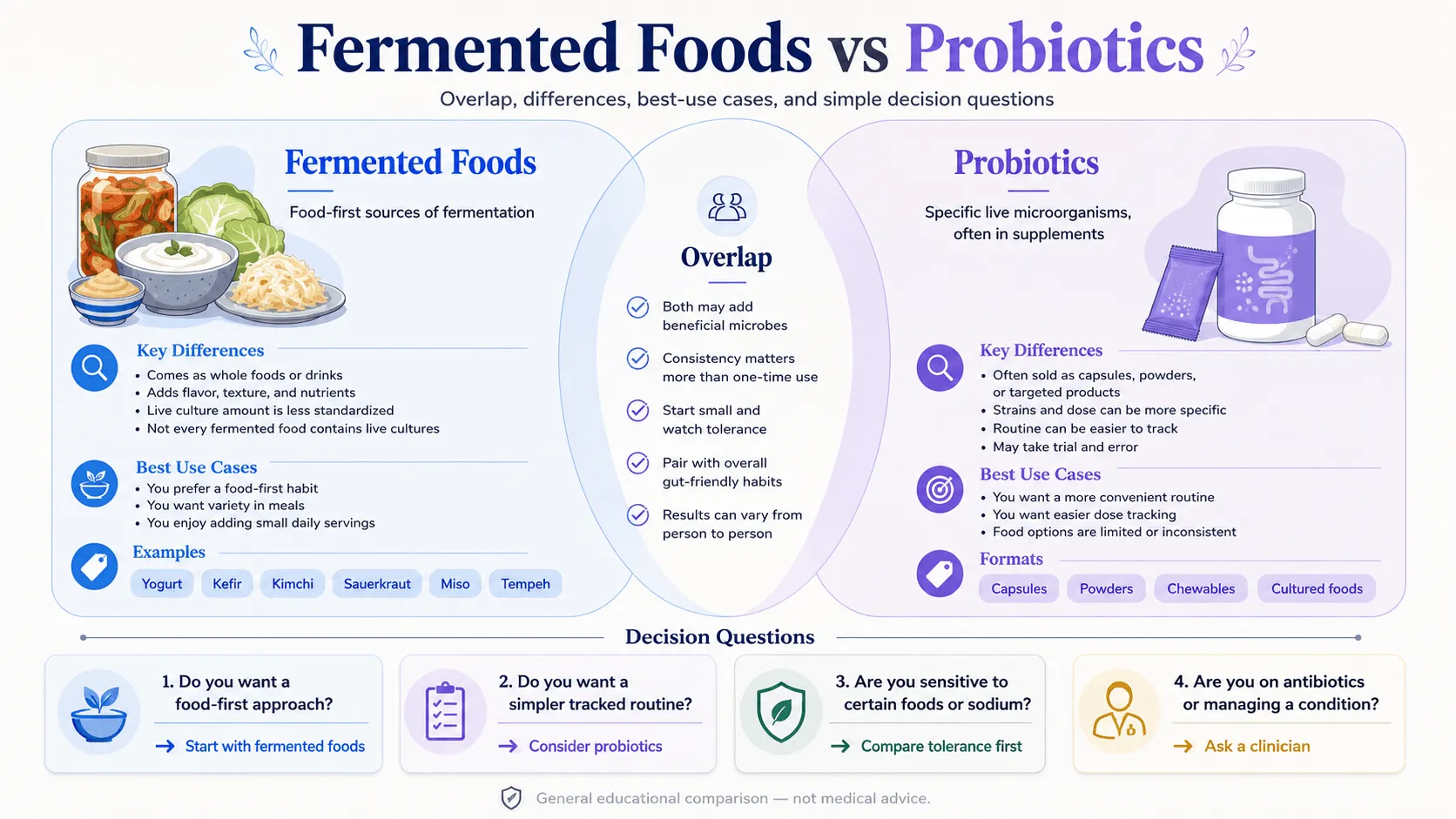
Decision Snapshot
| Scenario / Goal | Recommended Choice | Primary Rationale |
|---|---|---|
| Long-Term Daily Wellness | Fermented Foods | Cost-effective, whole-food matrix providing nutrients, organic acids, and micro-diversity. |
| Post-Antibiotic Recovery | Probiotic Supplements | High-dose, strain-specific organisms proven to reduce antibiotic-associated diarrhea. |
| Histamine Sensitivity / SIBO | Low-Histamine Probiotics | Raw fermented foods are rich in histamines; specific single-strain capsules avoid flare-ups. |
| Traveler's Diarrhea Prevention | Targeted Probiotic (e.g., S. boulardii) | Non-pathogenic probiotic yeast with strong clinical proof for travel protection. |
Red-Flag Symptoms & YMYL Safety Boundaries
While live microbes are safe for the vast majority of healthy individuals, live cultures pose serious clinical risks in specific medical situations.
Seek medical clearance before taking probiotic supplements or high-dose fermented foods if you:
- Are severely immunocompromised (e.g., undergoing chemotherapy, taking immunosuppressants, or living with advanced HIV)
- Have a central venous catheter or line (risk of probiotic bacteremia or fungemia)
- Suffer from severe short bowel syndrome, active leaky gut barrier disruption, or critical illness in an ICU
- Experience red-flag symptoms: high fever, severe bloody diarrhea, rapid weight loss, or persistent abdominal rigidity
Medical Disclaimer
This comparison is for educational purposes only and does not diagnose or treat medical conditions. Always discuss probiotic supplements or major dietary modifications with your physician or clinical dietitian.
Sources
- ISAPP Consensus Statement on Fermented Foods - International Scientific Association for Probiotics and Prebiotics
- Wastyk et al.: Gut-Microbiota-Targeted Diets Modulate Human Immune Status - Cell
- NIH ODS: Probiotics Fact Sheet for Health Professionals - National Institutes of Health
- NCCIH: Probiotics—Usefulness and Safety
Continue with a focused next step
Move from understanding this topic to one practical action, goal, or supporting guide.
Related guide
Fermented Foods for Gut Health: What Actually Helps?
Uncover how fermented foods boost microbiome diversity and short-chain fatty acids. Learn how to introduce live-culture foods without digestive distress.
Read guideRelated guide
Best Foods to Support a Healthy Gut Microbiome
Cut through superfood hype and discover the top foods for gut health. Learn the 3 functional pillars to nourish gut microbes and support smooth digestion.
Read guideRelated guide
Best Fiber Supplements for Constipation: Compare 4 Options
Compare psyllium, Metamucil, Citrucel and Benefiber for constipation. See evidence, label differences, bloating cautions and when to seek care.
Read guideResearch & transparency
We explain the evidence context, keep recommendations proportional, and identify uncertainty where it matters.
When to seek professional support
This page is educational and cannot diagnose a condition. Seek qualified care for severe, persistent, or worsening symptoms.
- Symptoms are severe, sudden, or worsening
- The concern persists despite reasonable self-care
- You are pregnant, taking medication, or managing a condition