
CoQ10 vs PQQ for Energy Support
Quick answer
Do you find yourself slumping at 2 PM, staring blankly at your monitor as afternoon brain fog takes over and your energy collapses? You search for cellular boosters and keep seeing CoQ10 and PQQ—promises of revitalized mitochondria and sharp mental focus. But which one actually powers your body out of chronic fatigue?
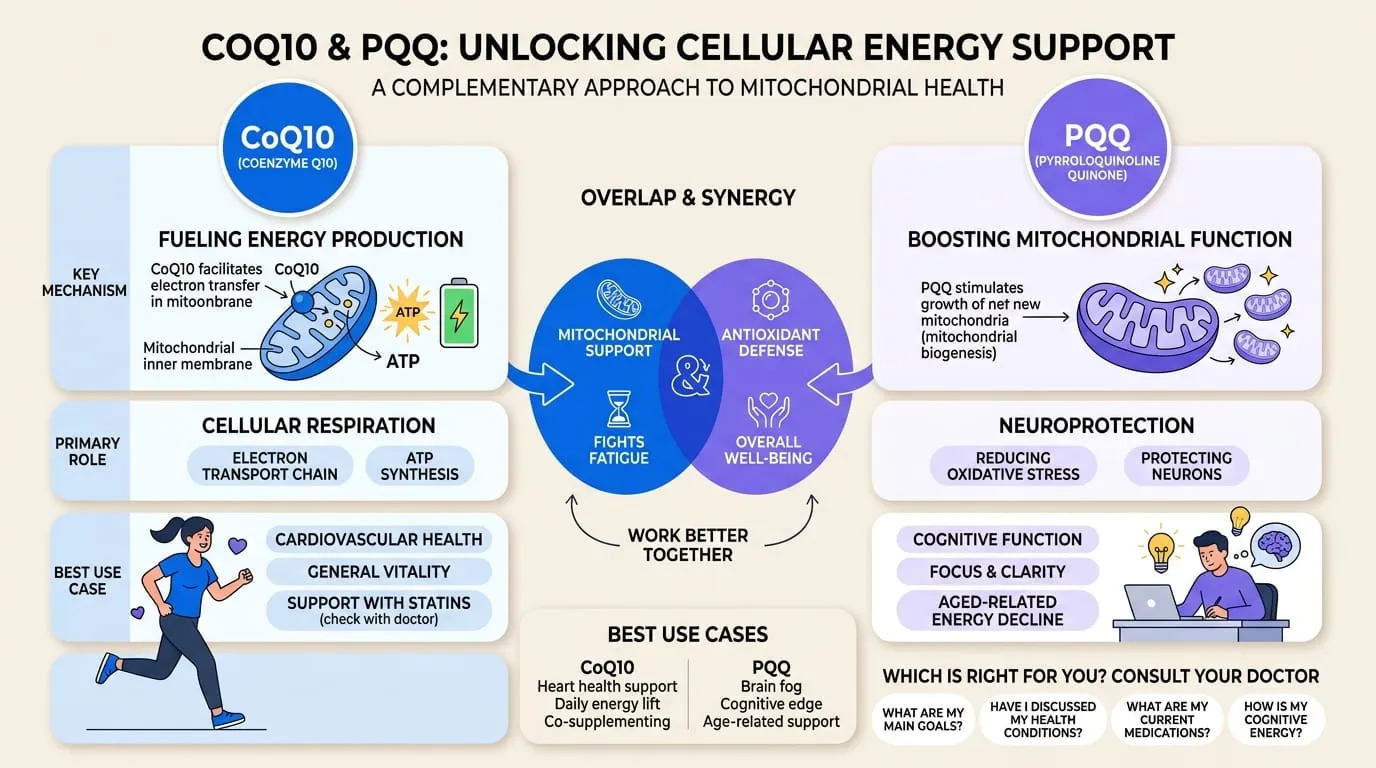
Coenzyme Q10 (CoQ10) acts as the vital spark plug inside your existing cellular power plants, essential for producing Adenosine Triphosphate (ATP) energy. Pyrroloquinoline Quinone (PQQ) acts like a factory expansion team, signaling cells to build brand-new mitochondria (mitochondrial biogenesis).
If your primary challenge is physical exhaustion or recovery from metabolic stress, CoQ10 has the strongest foundation of human clinical evidence. If you are seeking targeted cognitive support alongside cellular health, PQQ is an intriguing compound, though human trials remain small. For persistent, unexplained fatigue, neither supplement can replace evaluating fundamental sleep, thyroid, blood count, and lifestyle factors.
Evidence and Decision Table
| Feature / Question | Coenzyme Q10 (CoQ10) | Pyrroloquinoline Quinone (PQQ) |
|---|---|---|
| Biological Role | Essential cofactor in the mitochondrial electron transport chain (ATP synthesis) | Redox cofactor involved in cell signaling and stimulating mitochondrial biogenesis |
| Real-World Metaphor | The Spark Plug: Keeps your existing energy engine firing efficiently | The Factory Expansion Team: Helps build new power generators in cellular tissue |
| Human Fatigue Evidence | Moderate clinical trials showing benefit in specific fatigue settings and healthy adults | Limited human trials; primary clinical focus has been on cognitive test scores |
| Cognitive Support | Indirect benefits by supporting general cellular bioenergetics | Small randomized trials suggest minor improvements in focus and processing speed |
| Statin Interactivity | Statins lower body CoQ10 synthesis; supplementation is common (though trial data varies) | No established role or clinical evidence regarding statin-induced muscle symptoms |
| Safety Profile | Well-studied over decades; mild side effects like digestive upset or insomnia | Short-term safety established; long-term and pregnancy data remain sparse |
| Key Interactions | May interact with warfarin (blood thinners) and insulin regimens | Avoid during pregnancy, breastfeeding, or severe renal impairment without clinical guidance |
| Best Use Case | Baseline mitochondrial support for physical fatigue and high metabolic demands | Novel compound for combined cognitive and cellular optimization experiments |
Demystifying the Mechanics: How They Power Your Cells
To understand why these two nutrients are frequently paired, picture your cells as high-tech manufacturing plants.
CoQ10: The Spark Plugs of ATP Production
Inside every cell, micro-reactors called mitochondria convert the food you eat and the oxygen you breathe into ATP—the chemical energy currency that powers every muscle contraction and thought. Coenzyme Q10 sits directly inside the inner mitochondrial membrane. It functions like the spark plugs in a car engine: without CoQ10, electron transfer stalls, fuel cannot ignite efficiently, and ATP output drops while harmful free radicals leak out.
PQQ: The Factory Expansion Team
While CoQ10 optimizes your existing engines, PQQ works upstream. Through cell-signaling pathways (such as PGC-1α activation), PQQ acts like a factory expansion team. It sends signals telling the cell to build new mitochondrial power plants—a process known as mitochondrial biogenesis. Having more power plants reduces the individual load on older, damaged mitochondria.
3 Common Myths Debunked
Myth 1: "CoQ10 is strictly for physical stamina, while PQQ is strictly for mental energy."
The Reality: Both compounds operate at a fundamental cellular level across all tissues. While marketing campaigns frequently divide fatigue into rigid physical vs. mental buckets, your brain consumes nearly 20% of your body's total ATP. CoQ10 provides vital bioenergetic support to high-demand brain tissue, while PQQ's cell-signaling activity occurs in cardiac and muscular tissues as well.
Myth 2: "Taking PQQ can replace 8 hours of restorative sleep."
The Reality: No mitochondrial supplement can override acute or chronic sleep deprivation. Mitochondrial biogenesis and cellular cleanup (autophagy) primarily take place during deep slow-wave sleep. Taking PQQ while sleeping 5 hours a night is like hiring a construction crew to build a factory while the site is actively on fire.
Myth 3: "Ubiquinol is automatically 10x superior to Ubiquinone for every person."
The Reality: Ubiquinol (the reduced active antioxidant form) often demonstrates higher blood absorption in clinical studies compared to standard Ubiquinone (the oxidized form). However, healthy younger bodies easily convert Ubiquinone to Ubiquinol. A higher blood level does not automatically translate to a 10-fold reduction in physical fatigue if your tiredness stems from iron deficiency, thyroid dysfunction, or stress.
4-Step Action Plan for Sustained Energy
Step 1: Benchmark Your Fatigue Blueprint
Before purchasing mitochondrial supplements, determine whether your fatigue is driven by sleep debt, nervous system burnout, or metabolic strain.
- Action: Take our Energy Level Assessment to analyze your baseline patterns and pinpoint your primary energy leaks.
Step 2: Establish a Circadian and Sleep Recovery Foundation
Mitochondria require predictable light-dark cycles and deep sleep phases to repair damaged membranes and generate peak ATP.
- Action: Implement a structured evening protocol with our guide to Build a Daily Energy Recovery Plan and learn how to Improve Next-Day Energy Through Better Sleep.
Step 3: Implement a Tiered Supplement Trial
If lifestyle baseline measures are optimized and fatigue persists, begin a structured, single-variable trial.
- Action: Start with a high-quality CoQ10 (Ubiquinol 100–200 mg/day) taken with a fat-containing meal for 4 to 6 weeks. If tracking reveals room for cognitive support, explore evidence-backed options in our guide to the Best Supplements for Sleep and Next-Day Energy.
Step 4: Stabilize Fuel Delivery Through Dietary Habits
Prevent afternoon blood sugar spikes and crashes that force mitochondria to operate in panic mode.
- Action: Align your nutrition by following Build Stable Energy Through Food and uncover the physiological reasons behind afternoon slumps in Why You Get an Afternoon Energy Crash.
Decision Snapshot
| Goal / Situation | Recommended Starting Point | Key Rationale |
|---|---|---|
| Persistent Physical Fatigue | Coenzyme Q10 (CoQ10) | Superior volume of human clinical data supporting ATP cellular bioenergetics. |
| Cognitive Optimization Focus | PQQ (or CoQ10 + PQQ combo) | Preliminary trials show modest promises in cognitive processing scores. |
| Statin Therapy Support | CoQ10 (Clinician-Guided) | Statins inhibit the mevalonate pathway, reducing endogenous CoQ10 production. |
| Unexplained New Fatigue | Neither (Medical Evaluation) | Rule out anemia, thyroid disease, sleep apnea, or vitamin deficiencies first. |
Red-Flag Symptoms & Safety Boundaries
While CoQ10 and PQQ are generally well-tolerated, fatigue can be an early signal of serious medical conditions. Seek prompt medical evaluation if your fatigue is accompanied by:
- Chest pain, pressure, or irregular heartbeat (palpitations)
- Shortness of breath with minimal exertion or when lying flat
- Unexplained weight loss, night sweats, or persistent low-grade fever
- Severe muscle weakness, dark/tea-colored urine, or jaundice
- Sudden cognitive confusion, fainting, or severe mood changes
Drug Interaction Caution: CoQ10 has a chemical structure similar to Vitamin K and may decrease the blood-thinning effectiveness of Warfarin (Coumadin). It may also interact with insulin and certain chemotherapy agents. Always consult your prescribing physician before starting mitochondrial therapy.
Medical Disclaimer
This comparison is for educational purposes only and does not diagnose, treat, or cure any medical condition. Do not alter or discontinue prescribed medications (including statins, blood thinners, or psychiatric treatments) without direct medical supervision.
Sources
- Coenzyme Q10 Overview - National Center for Complementary and Integrative Health (NCCIH)
- Ubiquinol-10 Intake and Mild Fatigue in Healthy Individuals: Randomized Trial - Nutrients
- A Randomized Trial of Coenzyme Q10 in Patients With Confirmed Statin Myopathy - Atherosclerosis
- PQQ and Cognitive Function in Healthy Volunteers: Randomized Trial - Journal of the American College of Nutrition
- EFSA Safety Opinion on PQQ Disodium Salt - European Food Safety Authority
Continue with a focused next step
Move from understanding this topic to one practical action, goal, or supporting guide.
Health goal
Build a Daily Energy Recovery Plan
Stuck at 15% battery? Learn how mitochondrial ATP, adenosine drive, and nervous system downshifting build a daily energy recovery plan for lasting vitality.
View goalHealth goal
Build Stable Energy Through Food
Stop post-meal crashes. Discover how blood glucose stability, protein anchoring, and fiber pairing transform your food into steady, all-day energy.
View goalHealth goal
Improve Next-Day Energy Through Better Sleep
Wake up refreshed, not depleted. Master slow-wave sleep, glymphatic clearing, and adenosine clearance to maximize your next-day mental and physical energy.
View goalResearch & transparency
We explain the evidence context, keep recommendations proportional, and identify uncertainty where it matters.
When to seek professional support
This page is educational and cannot diagnose a condition. Seek qualified care for severe, persistent, or worsening symptoms.
- Symptoms are severe, sudden, or worsening
- The concern persists despite reasonable self-care
- You are pregnant, taking medication, or managing a condition