
Build a Daily Energy Recovery Plan
Quick answer
Stuck at 15% battery? Learn how mitochondrial ATP, adenosine drive, and nervous system downshifting build a daily energy recovery plan for lasting vitality.
Do You Feel Like Your Internal Battery Is Stuck at 15%?
Do you find yourself staring at your laptop screen at 2:30 PM with heavy eyelids, a fogged mind, and limbs that feel like lead? You hit the snooze button three times this morning, drained two large coffees before noon, yet by mid-afternoon you are desperate for a nap—only to feel wired, anxious, and unable to switch off when your head finally hits the pillow tonight.
If this cycle of exhaustion and hyper-arousal feels familiar, you are not alone. Fatigue is one of the most common physical complaints, yet most people treat it by throwing more stimulants at a depleted system. A true daily energy recovery plan does not promise non-stop peak performance; it gives your body a reliable blueprint to restore baseline vitality and recover from ordinary daily demands.
How Energy Recovery Works: The Solar Inverter and 50 Open Tabs
To understand why quick fixes fail, imagine your body as a solar power system paired with a high-performance computer:
- The Battery Inverter (Mitochondrial Production): Your cells generate energy (ATP) like solar inverters converting raw sunlight into usable current. When sleep is fragmented, nutrients are lacking, or stress is chronic, the inverter efficiency drops. Throwing extra caffeine at cold solar panels won't generate more electricity—it just overloads the circuit.
- 50 Open Browser Tabs (Cognitive & Nervous System Drain): Every unassigned task, late-night notification, unresolved conflict, and physical stressor operates like a background browser tab silently consuming RAM. Even if you aren't actively using the tab, your nervous system is spending precious energy keeping it running.
- The Engine in Neutral: When your body is stuck in chronic sympathetic ("fight-or-flight") tone, it's like revving a car engine to 5,000 RPM while idling in neutral. You burn through fuel rapidly without actually moving forward.
Recovery is the process of closing background tabs, cooling the inverter, and shifting the transmission back into drive.
3 Common Myths That Sabotage Your Daily Recovery
- Myth 1: Extreme Caffeination Fixes Fatigue. Caffeine does not create energy; it merely blocks adenosine receptors (the chemical signal that alerts your brain to sleep debt). Borrowing energy from tomorrow to get through today creates an escalating energy debt that leads to severe crashes.
- Myth 2: You Need an Elaborate 2-Hour Daily Routine. High-friction routines with ten different powders, cold plunges, and precise timing usually collapse the moment a busy workday hits. Effective recovery relies on simple, low-friction anchors you can sustain even on your hardest days.
- Myth 3: Fatigue Is Just a Failure of Willpower. Chronic tiredness is a biological signal, not a character flaw. It can stem from sleep apnea, thyroid dysfunction, iron deficiency, low vitamin D, poor gut absorption, or burnout. Pushing through without listening to your body's signals leads straight to exhaustion.
Actionable 4-Step Daily Recovery Protocol
Step 1: Assess Your Energy Drain Patterns
Before changing your lifestyle, record your energy baseline for 3 to 7 days. Track your morning wakefulness, post-lunch alertness, and evening wind-down ease on a 1-to-10 scale alongside caffeine intake and sleep duration.
Take the Energy Level Assessment to benchmark your current fatigue markers and pinpoint whether your primary bottleneck is sleep debt, nutritional gaps, or nervous system overload.
Step 2: Establish the 5 Minimum Daily Anchors (Tier 1 Baseline)
Build a resilient baseline around five non-negotiable daily anchors for 14 consecutive days:
- Consistent Wake Time: Set your alarm for the same window (+/- 30 minutes) 7 days a week to anchor your circadian rhythm.
- Morning Photonic Cue: Step outside within 30–60 minutes of waking for 10–15 minutes of natural sunlight.
- Balanced Midday Fuel: Eat a meal containing high-quality protein, complex fiber, and healthy fats to avoid post-prandial glucose spikes.
- Deliberate Micro-Rest: Take 5–10 minutes in the early afternoon for non-sleep deep rest (NSDR) or slow diaphragmatic breathing without screens.
- Evening Signal Boundary: Turn off work notifications and dim overhead lights 60 minutes before bed.
Step 3: Implement Targeted Bio-Nutritional Support (Tier 2 Optimization)
Once your daily anchors are established, consider targeted nutritional and adaptogenic support to optimize mitochondrial function and stress resilience:
- Mitochondrial Co-factors: Coenzyme Q10 (CoQ10) and PQQ support cellular ATP production in tissue with high energy demands.
- Adaptogenic Nervous System Support: Ingredients like Ashwagandha or Rhodiola Rosea help modulate cortisol responses during high-stress periods.
- Magnesium Glycinate or Threonate: Supports neuromuscular relaxation and evening wind-down.
Explore evaluated recommendations in our guide on the Best Supplements for Sleep and Next-Day Energy.
Step 4: Conduct a Weekly Pacing Review (Tier 3 Fine-Tuning)
At the end of each week, compare your daily energy scores and adjust one variable at a time:
- If energy crashes at 2 PM: Move caffeine earlier (before 12 PM) and increase lunchtime protein.
- If morning grogginess lasts > 60 minutes: Extend bedtime by 30 minutes and increase morning outdoor light exposure.
- If energy remains low despite good habits: Prepare your log for a clinical evaluation.
When to Seek Medical Evaluation (Red-Flag Symptoms)
While lifestyle recovery plans improve ordinary fatigue, persistent or severe exhaustion requires medical diagnostic evaluation.
Schedule a healthcare visit if:
- Fatigue persists for more than 2–3 weeks despite adequate sleep and rest.
- You experience unexplained weight loss, night sweats, persistent fever, or swollen lymph nodes.
- You have heavy menstrual bleeding, pale skin, or cold intolerance (potential signs of anemia or thyroid disease).
- You snore loudly, wake up gasping, or have witnessed pauses in breathing during sleep.
Seek IMMEDIATE emergency care if fatigue is accompanied by:
- Chest pain, pressure, or shortness of breath.
- Fainting (syncope), severe dizziness, or sudden confusion.
- Sudden muscle weakness, numbness, or difficulty speaking.
- Thoughts of self-harm.
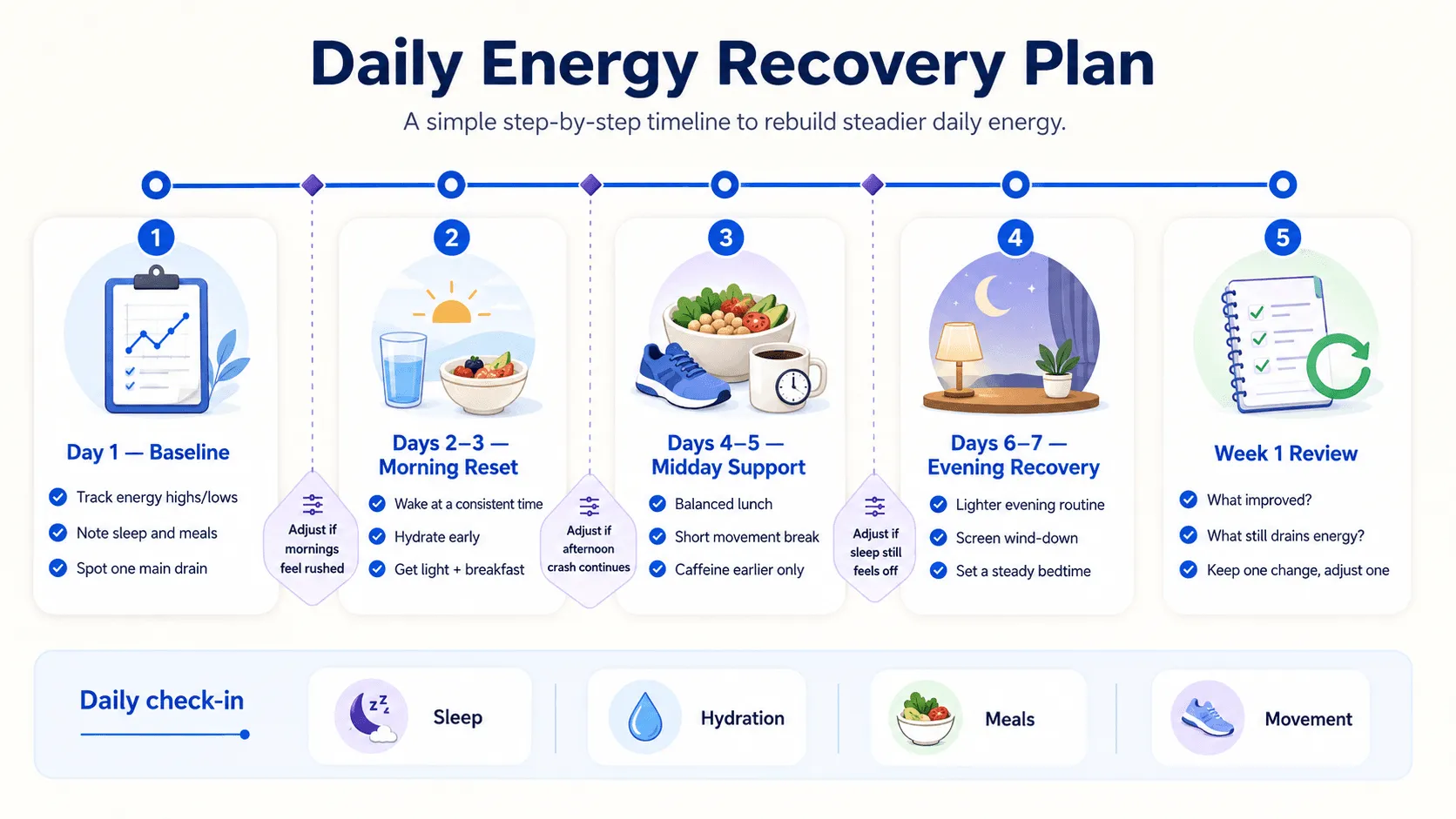
Progress Checkpoints
| Stage | Main Action | What to Review |
|---|---|---|
| Step 1: Baseline Assessment | Complete tool assessment & track 3 days | Identify peak energy drain windows |
| Step 2: Core Anchors | Implement 5 minimum anchors for 14 days | Rate wakefulness & evening ease |
| Step 3: Targeted Bio-Support | Introduce targeted nutritional support | Track afternoon stamina & recovery |
| Step 4: Weekly Fine-Tuning | Adjust caffeine cutoff & meal composition | Review 14-day energy trends |
Related Tools and Guides
- Try the Energy Level Assessment
- Build Stable Energy Through Food
- CoQ10 vs PQQ for Energy Support
- Why You Get an Afternoon Energy Crash
- Best Supplements for Sleep and Next-Day Energy
- Improve Next-Day Energy Through Better Sleep
Medical Disclaimer
This article is for general educational purposes only and does not constitute medical advice, diagnosis, or treatment. Daily recovery routines support lifestyle factors but cannot replace professional medical evaluation for chronic conditions. Always consult a qualified healthcare provider before starting new supplements or modifying prescribed treatment plans.
Sources
- Fatigue Overview - MedlinePlus, U.S. National Library of Medicine
- Healthy Sleep Habits - National Heart, Lung, and Blood Institute
- Benefits of Physical Activity - Centers for Disease Control and Prevention
- Caffeine and Daily Health - U.S. Food and Drug Administration
Continue with a focused next step
Move from understanding this topic to one practical action, goal, or supporting guide.
Health goal
Build Stable Energy Through Food
Stop post-meal crashes. Discover how blood glucose stability, protein anchoring, and fiber pairing transform your food into steady, all-day energy.
View goalRelated guide
CoQ10 vs PQQ for Energy Support
Compare CoQ10 vs PQQ for cellular energy and brain fog. Learn how spark plugs and mitochondrial biogenesis differ, plus a 4-step fatigue action plan.
Read guideRelated guide
Why You Get an Afternoon Energy Crash
Understand the circadian and metabolic drivers behind 3 PM slumps. Discover 4 actionable steps to balance blood sugar and sustain focus all afternoon.
Read guideResearch & transparency
We explain the evidence context, keep recommendations proportional, and identify uncertainty where it matters.
When to seek professional support
This page is educational and cannot diagnose a condition. Seek qualified care for severe, persistent, or worsening symptoms.
- Symptoms are severe, sudden, or worsening
- The concern persists despite reasonable self-care
- You are pregnant, taking medication, or managing a condition