
Why Do Ultra-Processed Foods Make Weight Control Harder?
Quick answer
Diets dominated by ultra-processed foods may make weight control harder because many of these foods are quick to eat, energy-dense, heavily marketed, and easy to consume without preparation. In a small NIH inpatient trial, adults ate more energy and gained weight during an ultra-processed diet compared with a minimally processed diet.
That study does not prove that every packaged food is harmful, that one additive caused the result, or that ultra-processed foods must be eliminated. Start with the foods that contribute the most to your routine, then improve one recurring meal or snack while protecting affordability, convenience, and adequate nutrition.
What “ultra-processed” means
Most research uses the NOVA classification, which groups foods by the nature and purpose of processing. Ultra-processed foods are generally industrial formulations made largely from refined ingredients and substances not commonly used in home cooking, often with flavorings, colors, emulsifiers, sweeteners, or other additives.
Examples can include soft drinks, confectionery, many packaged snack foods, instant meals, reconstituted meat products, and some sweetened cereals or desserts.
Processing itself is not the enemy. Washing, freezing, canning, fermenting, pasteurizing, and cooking can make food safer and more accessible. Frozen vegetables, canned beans, canned fish, plain yogurt, whole-grain bread, and fortified foods may be practical parts of a nutritious diet even though they are processed.
NOVA is useful for research, but borderline products can be classified differently. An ingredient list alone does not tell you whether a food fits your needs, and “minimally processed” does not automatically mean nutritionally balanced.
What the strongest experiment found
In the 2019 NIH randomized crossover trial, 20 adults lived in a metabolic ward and received an ultra-processed diet for two weeks and an unprocessed diet for two weeks, in random order. The diets offered were matched for several nutrients, and participants could eat as much or as little as they wanted.
Participants consumed more energy and gained weight during the ultra-processed phase, while they lost weight during the unprocessed phase. They also ate faster during the ultra-processed diet.
The controlled setting makes the result important, but the trial was small and short. It tested entire dietary patterns, not every product. Researchers still debate which features mattered most, including energy density, eating rate, texture, food structure, palatability, or other factors.
The responsible conclusion is narrow: an ultra-processed dietary pattern can cause higher intake in at least some conditions. It is not evidence that all additives are toxic or that one serving overrides the rest of a diet.
Why these foods can be easy to overconsume
Speed and texture
Foods that require little chewing can deliver energy quickly. Drinks, soft breads, pastries, chips, and some ready-to-eat meals may be consumed before the eating experience has time to feel complete.
This is not universal. A dense snack bar can be slow to eat, while a homemade sweet drink can be consumed quickly. Look at the actual food, not only the category.
Energy density and portion format
Some products pack substantial energy into a small weight or volume. Large bags, multipacks, and food eaten directly from its container also remove visible stopping points.
Serving a portion and pairing it with fruit, vegetables, yogurt, beans, or another substantial food can change the meal without banning the product.
Convenience shapes the default
The food that is available at the exhausted end of a workday often wins. Ultra-processed products are inexpensive, portable, predictable, and shelf-stable. These are real advantages, particularly where time, cooking facilities, transportation, or food access are limited.
Advice that ignores those constraints is not practical. The goal is to make a satisfying option at least as easy as the current default.
Repeated cues
Some products become tied to screens, commuting, stress, or a specific time. The cue can prompt eating before physical hunger. This is a learned routine, not proof of chemical addiction.
Do not turn the category into a purity rule
Eliminating all ultra-processed food is unrealistic for many people and may remove useful foods such as fortified products or convenient options that make adequate eating possible.
A packaged item can still contribute protein, fiber, or micronutrients. Conversely, a meal made entirely at home can be high in energy and low in produce or fiber. Processing level is one lens, not a complete nutrition score.
Rigid avoidance can also worsen food fear or restrict eating socially. People with an eating-disorder history should be especially cautious with purity-based rules.
Improve the highest-impact part of your routine
Find the main contributor
For three to seven days, note the ultra-processed foods that appear most often. Do not count every additive. Look for a recurring meal, drink, or open-ended snack that leaves you hungry, is easy to overeat, or displaces more substantial food.
Upgrade rather than erase
Possible changes include:
- add yogurt and fruit to a cereal breakfast
- combine instant noodles with eggs, tofu, or frozen vegetables
- replace some sweet drinks with water or unsweetened alternatives
- serve chips in a bowl beside a sandwich and fruit rather than eating from the bag
- keep canned beans, frozen vegetables, eggs, or plain oatmeal available for quick meals
These are examples, not moral rankings. The best change fits your culture, budget, allergies, cooking access, and health needs.
Slow one eating occasion
Sit down, use a plate or bowl, and give the first part of the meal your attention. Add a food that requires chewing. You do not need a prescribed bite count; simply make the meal less automatic.
Preserve satisfaction
A replacement that tastes bad or leaves you hungry will not last. Include enough food, plus a protein source, produce or another fiber-rich food, and carbohydrate or fat that makes the meal complete.
Track whether the change helps
For two weeks, record:
- how often the target meal or snack occurred
- whether it was eaten from a package or served
- hunger before and satisfaction afterward
- whether another snack followed soon
- weekly food cost and preparation burden
- weight or waist trend, only if appropriate
Keep the change if it improves satisfaction and remains feasible. If the “healthier” version costs too much, takes too long, or leads to rebound eating, simplify it.
Weight is only one outcome. Blood pressure, blood lipids, glucose, digestive tolerance, and overall dietary adequacy may matter too, and some require clinical measurement.
When to seek support
Consult a clinician or registered dietitian for unexplained weight change, persistent fatigue, diabetes symptoms, digestive problems, or a diet limited by allergy, kidney disease, pregnancy, or another condition. Recurrent loss-of-control eating, purging, or severe food anxiety deserves prompt support.
Do not use unapproved “detox” products or supplements to offset ultra-processed food. They do not undo a dietary pattern and may create new risks.
Medical disclaimer: This article is educational and does not classify every food for you or provide an individualized medical nutrition plan.
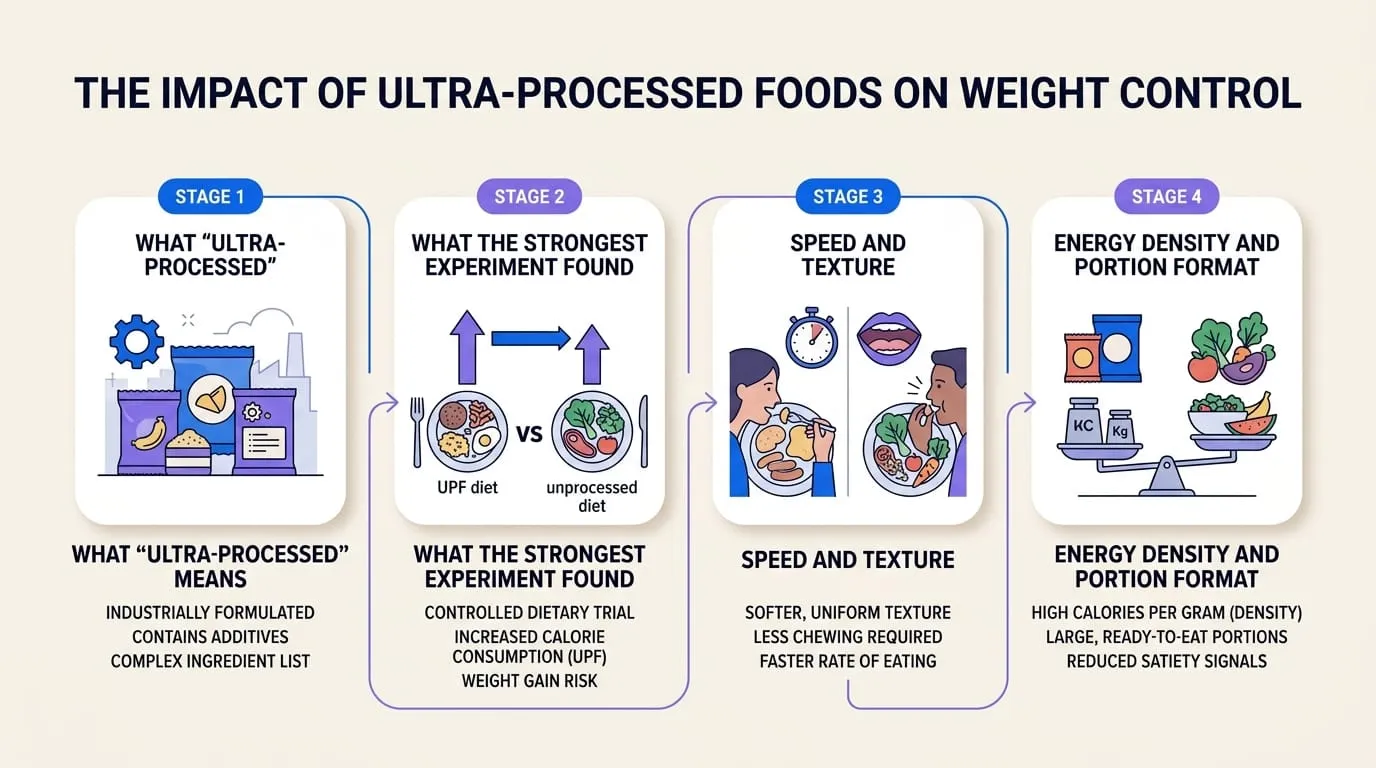
Mechanism Map
The article can be read as a simple pathway:
- What “ultra-processed” means: Most research uses the NOVA classification, which groups foods by the nature and purpose of processing.
- What the strongest experiment found: In the 2019 NIH randomized crossover trial, 20 adults lived in a metabolic ward and received an ultra-processed diet for two…
- Speed and texture: Foods that require little chewing can deliver energy quickly.
- Energy density and portion format: Some products pack substantial energy into a small weight or volume.
This pathway explains a plausible connection; it does not prove that one factor is the only cause for every person.
Related Tools and Guides
- Try the Bmi Calculator
- Metabolic Health vs Weight Loss: Why the Scale Is Not the Whole Story
- Improve Metabolic Health: A Practical Path Beyond Weight Loss
- Lose Weight Without Constant Hunger
- Best Fiber Supplements for Weight Management
- Best Protein Powders for Weight Management
Sources
Continue with a focused next step
Move from understanding this topic to one practical action, goal, or supporting guide.
Related guide
Metabolic Health vs Weight Loss: Why the Scale Is Not the Whole Story
Scale weight misses your true cellular health. Compare weight loss vs metabolic health, understand insulin resistance, and follow a 4-step action plan.
Read guideHealth goal
Improve Metabolic Health: A Practical Path Beyond Weight Loss
Struggling with sugar cravings & fatigue? Improve insulin sensitivity, boost metabolic flexibility, and optimize biomarkers beyond scale weight.
View goalHealth goal
Lose Weight Without Constant Hunger
End the starvation diet cycle. Master satiety signaling, protein leverage, and high-volume fiber to shed weight naturally without constant hunger.
View goalResearch & transparency
We explain the evidence context, keep recommendations proportional, and identify uncertainty where it matters.
When to seek professional support
This page is educational and cannot diagnose a condition. Seek qualified care for severe, persistent, or worsening symptoms.
- Symptoms are severe, sudden, or worsening
- The concern persists despite reasonable self-care
- You are pregnant, taking medication, or managing a condition