
Stress vs Anxiety: What’s the Difference?
Quick answer
Do you lie awake at 2 AM with a pounding heart and tight chest, unable to quiet your racing mind even though your workday ended hours ago?
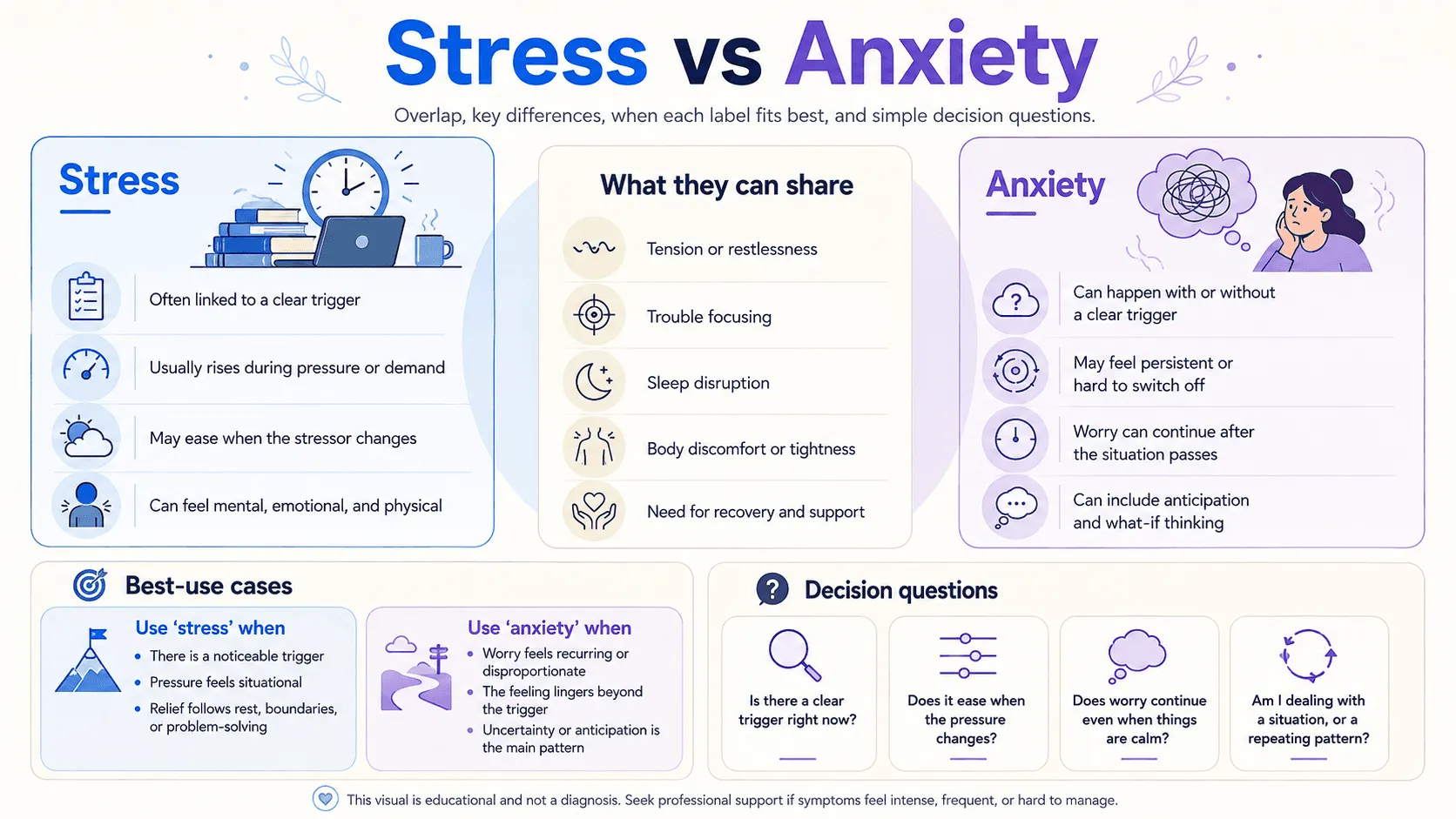
While people frequently say "I'm so stressed out" and "I have so much anxiety" as if they are the exact same state, clinicians separate them by their trigger and persistence:
- Stress is typically a reaction to an identifiable external threat or demand—such as a tight project deadline, a heated argument, financial strain, or caregiving load. Once the demand resolves, stress generally subsides.
- Anxiety is an internal, persistent threat response—marked by ongoing worry, fear, or hypervigilance that continues long after an external stressor has passed, or arises when no clear external danger exists.
Because both trigger identical physiological fight-or-flight hormones (cortisol, adrenaline), understanding whether you are dealing with external overload (Stress) or an overactive internal alarm system (Anxiety) is essential for choosing the right recovery tools.
Evidence and Decision Table
| Dimension / Feature | Acute or Chronic Stress | Anxiety or Anxiety Disorder |
|---|---|---|
| Primary Trigger | Clear external demand (workload, conflict, financial pressure, illness) | Internal perception of future danger, uncertainty, or "what-if" scenarios |
| Real-World Metaphor | The Overloaded Weight Machine: Physical strain caused by carrying a heavy external load | The Glitchy Smoke Detector: An alarm blaring continuously even when there is no active fire |
| Duration & Trajectory | Elevates around the external demand; settles when the stressor ends or rest occurs | Persists across different situations; may shift focus from one worry to another |
| Primary Mindset | Focuses on frustration, pressure, fatigue, and "how will I get all this done?" | Focuses on anticipated catastrophe, loss of control, dread, and "what if something terrible happens?" |
| Avoidance Behavior | Minimal to moderate; driven by exhaustion or wanting to escape a specific task | High; fear-driven avoidance of safe situations (social settings, open spaces, triggers) |
| Physical Symptoms | Muscle tension, headaches, stomach upset, fatigue, elevated heart rate | Racing heart, chest tightness, shallow breathing, trembling, panic attacks |
| First-Line Solution | Reduce external load, set boundaries, restore sleep and physical recovery | Evidence-based therapy (CBT), cognitive reframing, exposure work, medical review |
Demystifying the Mechanics: Overloaded Weight Machines vs. Glitchy Smoke Detectors
To regain calm, understand how your autonomic nervous system responds to pressure.
Stress: The Overloaded Weight Machine
Imagine walking into a gym and loading 300 pounds onto a weight machine. Your muscles strain, your heart pumps faster, and your blood pressure surges to hold the weight up. This is stress—a natural, physiological mobilization in response to an external load. When you rack the weights and rest, your muscles relax and your heart rate recovers. Stress becomes dangerous only when you carry the heavy load 24 hours a day without ever putting the bar down.
Anxiety: The Glitchy Smoke Detector
Now imagine sitting comfortably in your living room with no smoke, heat, or fire anywhere, but your smoke detector is screeching at 100 decibels. Your brain's threat center (the amygdala) has sent a false signal that you are in mortal danger. Your body floods with adrenaline, your chest tightens, and your heart races—even though you are sitting safely on your couch. This is anxiety—an internal alarm firing out of proportion to actual real-time danger.
3 Common Myths Debunked
Myth 1: "Anxiety is just severe stress, and you just need to be mentally tougher."
The Reality: Stress is an external demand response, whereas clinical anxiety disorders involve altered neural threat-processing pathways in the brain (including amygdala-prefrontal cortex dysregulation). Telling someone with an anxiety disorder to "just stop stressing" is like telling someone with astigmatism to "just look harder." It requires targeted cognitive and physiological tools, not willpower.
Myth 2: "Physical symptoms like a racing heart and chest tightness always mean you are having a panic attack."
The Reality: Somatic symptoms like palpitations, shortness of breath, trembling, and dizziness overlap heavily across cardiac, endocrine, and metabolic conditions. Thyroid disorders (hyperthyroidism), anemia, cardiac arrhythmias, hypoglycemia, and caffeine toxicity can mimic anxiety perfectly. New physical symptoms must be evaluated medically rather than written off as "just stress."
Myth 3: "Taking OTC nerve supplements or adaptogens can cure clinical anxiety on their own."
The Reality: While nutritional support (like magnesium, L-theanine, or ashwagandha) can support baseline nervous system balance, supplement pills cannot rewire fear-driven avoidance patterns or cognitive distortions. Evidence-based treatments like Cognitive Behavioral Therapy (CBT), exposure therapy, and clinician-prescribed care remain the gold standard for clinical anxiety disorders.
4-Step Action Plan to Calm Your Nervous System
Step 1: Benchmark Your Current Stress & Anxiety Profile
Determine whether your physical symptoms reflect acute workload burnout or internal worry loops.
- Action: Complete our interactive Stress Level Check In.
Step 2: De-escalate Acute Physical Arousal Signals
When adrenaline surges, use somatic nervous system down-regulation (such as extended-exhale breathwork or progressive muscle relaxation) to signal safety to your brainstem.
- Action: Learn immediate grounding techniques in What to Do When Anxiety Spikes Suddenly and explore cognitive reset tools in Why Your Mind Won’t Stop Racing.
Step 3: Regulate Nocturnal Cortisol and Sleep Disruption
Address the nighttime cortisol spikes that keep your mind spinning at 2 AM.
- Action: Follow our guide on Overthinking at Night: Why It Gets Worse in Bed and understand physiological arousal mechanisms in Cortisol and Stress: Why Your Body Feels Wired.
Step 4: Address the Gut-Brain Connection and External Load
Reduce unmanageable life stressors while supporting gut-brain signaling (where over 90% of your body's serotonin is synthesized).
- Action: Investigate how chronic strain impacts your body in Why Does Chronic Stress Make You Feel Sick? and explore targeted relief in Best Supplements for Stress-Related Digestive Discomfort.
Decision Snapshot
| Symptom / Experience | Primary Pattern | Recommended First Step |
|---|---|---|
| Overwhelmed by work deadlines; relaxes on vacation | External Stress | Audit commitments; renegotiate boundaries; schedule mandatory sleep recovery. |
| Constant dread and 'what-if' worry with no clear trigger | Anxiety Response | Practice cognitive reframing; consult a licensed therapist for CBT evaluation. |
| Sudden panic episodes, racing heart, fear of dying | Panic Attack / Anxiety | Use 4-7-8 extended breathing; rule out medical causes with a physician. |
| Physical exhaustion, stomach aches, and irritability | Chronic Stress Load | Check cortisol recovery, optimize gut nutrition, and reduce daily stimulant intake. |
Red-Flag Symptoms & Medical Safety Boundaries
Mental health and cardiovascular health share many identical physical warning signs. It is critical to distinguish anxiety from acute medical emergencies.
Seek immediate emergency medical care (Call 911 / Visit ER) if you experience:
- New or severe chest pain, pressure, tightness, or pain radiating to your jaw, neck, or arm
- Sudden shortness of breath, fainting (syncope), or severe dizziness
- Sudden numbness, weakness on one side of the body, or difficulty speaking
- Thoughts of self-harm, suicide, or an inability to keep yourself safe
Immediate Crisis Support: If you or someone you know is struggling with a mental health crisis or thoughts of self-harm, call or text 988 to reach the Suicide & Crisis Lifeline (US/Canada) or contact your local emergency services immediately.
Medical Disclaimer
This comparison is for educational purposes only and cannot diagnose a mental health or medical condition. Never alter or discontinue prescribed psychiatric or cardiovascular medications without direct clinical guidance.
Sources
- National Institute of Mental Health: Anxiety Disorders - NIMH
- MedlinePlus: Stress and Your Health - U.S. National Library of Medicine
- National Institute of Mental Health: Panic Disorder
- PubMed: Long-term Outcomes of Cognitive Behavioral Therapy for Anxiety-Related Disorders - Systematic Review & Meta-Analysis
Continue with a focused next step
Move from understanding this topic to one practical action, goal, or supporting guide.
Related guide
What to Do When Anxiety Spikes Suddenly
Hit by a sudden surge of anxiety or chest tightness? Learn how the fight-or-flight response escalates panic and follow a 10-minute grounding plan.
Read guideRelated guide
Why Does Chronic Stress Make You Feel Sick?
Experiencing unexplained physical symptoms from constant stress? Discover how allostatic load wears down immunity and follow 4 steps to break the cycle.
Read guideRelated guide
Cortisol and Stress: Why Your Body Feels Wired
Wondering how cortisol impacts your stress and stamina? Learn what the stress hormone actually does, signs of dysregulation, and how to balance it.
Read guideResearch & transparency
We explain the evidence context, keep recommendations proportional, and identify uncertainty where it matters.
When to seek professional support
This page is educational and cannot diagnose a condition. Seek qualified care for severe, persistent, or worsening symptoms.
- Symptoms are severe, sudden, or worsening
- The concern persists despite reasonable self-care
- You are pregnant, taking medication, or managing a condition